
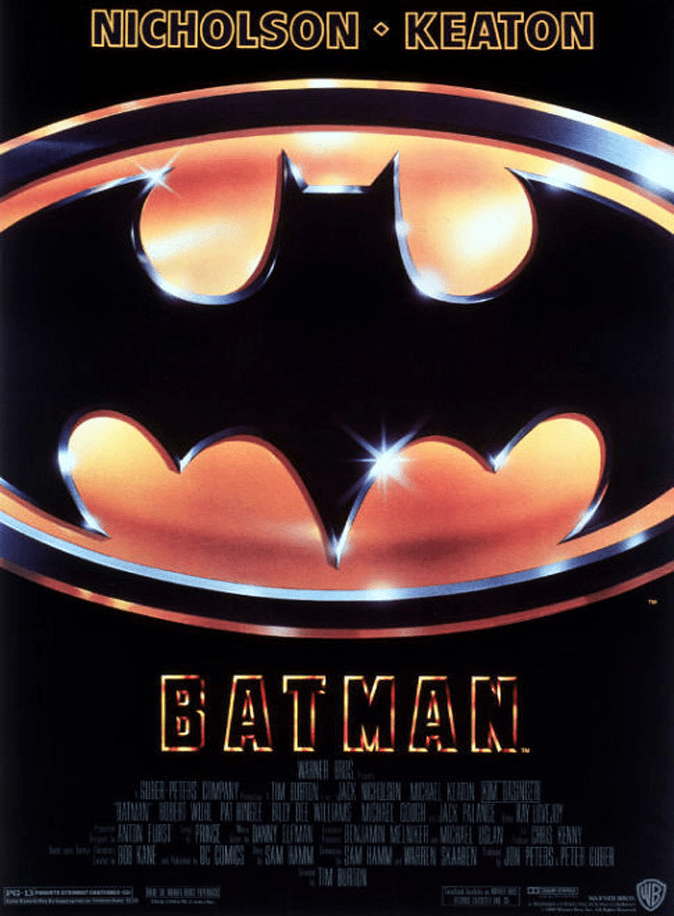
Director: Tim Burton
Writers: Bob Kane (Batman characters), Sam Hamm (story)
Stars: Michael Keaton, Jack Nicholson, Kim Basinger
Let’s take a trip down memory lane to a time when, as a kid, I wasn’t really into comic books or graphic novels. Instead, I was “subjected” to classic TV series like Batman, The Incredible Hulk, and Spider-Man. The Batman TV series of the 1960s, with Adam West in the lead, was my introduction to the Caped Crusader up until I was 13. Then, out of the blue, I saw the first photograph of Michael Keaton as the Dark Knight, and it left me mesmerized. This new incarnation of Batman struck me as both terrifying and utterly captivating.
I don’t recall much fanfare when Keaton’s casting was announced. Perhaps, coming off his role in “Beetlejuice,” it seemed like a case of two old pals, Burton and Keaton, reuniting. Nevertheless, fans weren’t disappointed, as many regard Keaton as the best Bruce Wayne and the best Batman, individually and as a whole. And then, there was the introduction to the menacing “Joker.” I still think that Cesar Romero’s portrayal is celebrated, but Jack Nicholson’s version was even darker and more terrifying than Keaton’s Batman.
One thing was certain: Tim Burton had brought a darker, more sinister version of these characters to the screen than I was accustomed to. The Bat-Suit was darker, torn, menacing, and mysterious. Burton’s vision of Gotham City included seedier characters, giving me a better understanding of Bruce Wayne’s mission and predicament. Burton, however, openly admitted he wasn’t a comic book enthusiast and that he didn’t make the movie for hardcore comic book geeks. There’s evidence of this in how the Joker’s origin story was altered, including his involvement in the demise of Thomas and Martha Wayne, which became pivotal to Bruce’s quest for vengeance and the revelation of how evil Jack Napier (The Joker) truly was. Of course, I would later discover that it was actually Joe Chill who set young Bruce on the path to becoming the symbol of hope for Gotham City.
Did the tone shift dramatically from the 1960s series? I’d say about 98% of it did. The remaining 2% paid tribute to those iconic angle shots we saw in the TV series, and a few of Batman’s gadgets remained intact. Even Jack Nicholson got his musical moment thanks to Prince’s “Party Man.” But the most significant tonal shift was the decision to portray Batman as a lone hero, with no Robin in sight. Burton made a bold statement that he was creating his film and his vision for Batman and any potential sequels.
Michael Keaton was a fantastic casting choice for the role, and in hindsight, it stands as one of his career highlights. He masterfully portrayed the two distinct personas required for the character through his actions, speech patterns, and delivery. Keaton played the role of Bruce Wayne with a sense of mystery that I had never seen before, even though his trademark black humor and edginess still shone through. This subtle touch of craziness seemed to seep into every character he played, and here, it felt like a therapeutic descent from his wild role in “Beetlejuice” into the more complex character of Bruce Wayne. While Val Kilmer managed some of this complexity in “Batman Forever” (1995), George Clooney’s version in “Batman and Robin” (1997) lost that sense of mystery, making him appear more like a celebrity than the brooding, enigmatic Dark Knight. Thankfully, the character had a resurgence in Christian Bale’s “Dark Knight Trilogy,” which carried through to Ben Affleck’s recent portrayal. Keaton laid the foundation for this resurgence in 1989, and most fans still consider him the best Batman.
Jack Nicholson’s portrayal of the Joker left an indelible mark on me. I recall thinking at the time that the role was tailor-made for him. Rumors swirled around that Robin Williams might play a potential Riddler character, which could have been equally interesting. However, if you’re stepping into the DC comic book cinematic world, your villain must be Batman’s arch-nemesis. Jack Nicholson was the best fit at the time. I was a bit disheartened when, after Heath Ledger’s iconic performance, fans began to compare both portrayals, which felt unfair to both actors. They had different directions for the character, with Nicholson having only Cesar Romero’s 1960s version as a point of comparison. Ledger was brilliant and my personal favorite, but that doesn’t take away from Jack’s equally impressive performance. They were different in every way but equally exceptional.
Overall, “Batman” (1989) was a game changer, although it could have gone terribly wrong on paper. Just look at films like “Captain America” (1990) or “Daredevil” (2003). Fortunately, it paved the way for a darker look at comic book heroes. This might seem like an overstatement, and perhaps this change would have occurred over time through graphic novels, particularly those by Frank Miller. Nevertheless, films like “Watchmen,” “The Crow,” and some of the darker DCEU and MCU films all took a page out of Burton’s book. This review is more of an appreciation for the impact the film had on comic book culture in its day. When you view this movie today, keep in mind that it still holds up in most aspects. Some of the choreography might seem a bit dated, and the Batsuit looks like it was cut with a utility knife. The sets have a distinct “set” quality, even with today’s CGI capabilities, but they have a charm that unintentionally pays homage to the Adam West era. It’s a film that should be appreciated for what it was in its time and not compared to what came after. Highly recommended.
 Movie Burner Entertainment
Leave a comment