
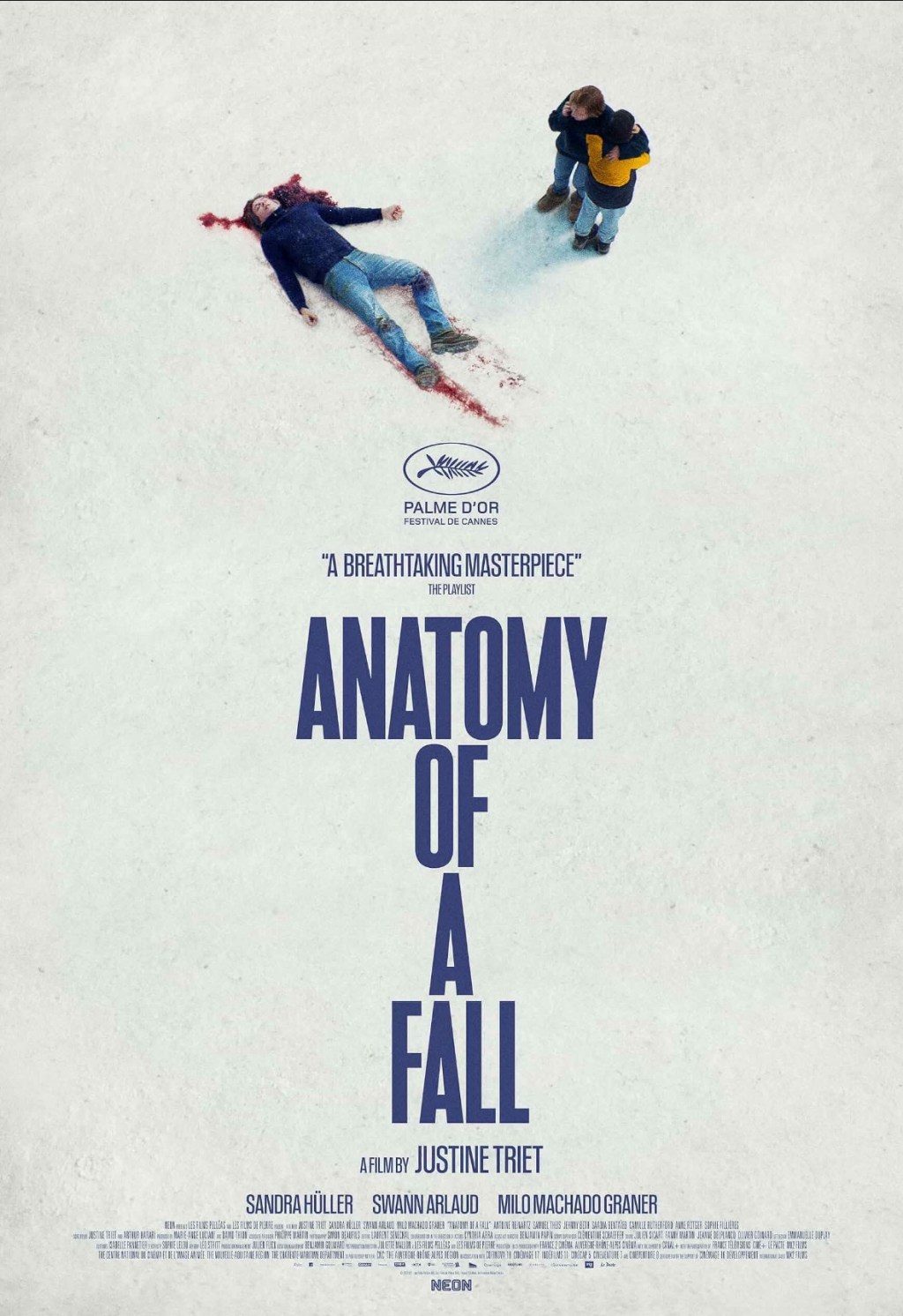
Director: Justine Triet
Writers: Justine Triet, Arthur Harari
Stars: Sandra Hüller, Swann Arlaud, Milo Machado Graner
A German writer is suspected of murdering her husband allowing a lengthy trial to dissect their private life in front of their son, a key witness in the case…
Guilt is an interesting thing. In my younger days, I would resign to believe that guilt, as determined by the court of law, was a tried and true formula, a pin-point accurate breakdown of societal functions with no political agenda, but in the wake of tragedy after tragedy, overturned racial cases dating back forty years, domestic abuse allegations prominently displayed on TikTok live streams for everyone to dissect into oblivion, it would seem that the judicial system in the world at large is more akin to grasping at straws, placating to people in the hopes of occasionally finding objective truth.
Anatomy Of A Fall toys with the notion of our fundamental understanding of guilt from the very outset of the film. The interview with our protagonist, a popular author Sandra Hoyter (played by Sandra Huller), immediately flags in the audience’s mind as suspicious. There are moments of sensory ticks, and oddities that layer over this initial conversation, whether they be the bombastic music that rudely interrupts the interaction with little to no explanation, or the mid-day wine offering as a guise to steer clear of sensitive topics.
From the outset, Anatomy of a Fall establishes a delicate foundation that demands intense scrupulous focus in order to determine the audience’s alignment. Once the death at the heart of the story unveils itself, the audience is forced to grapple with their own suspicions. In such a short frame of time, Anatomy of a Fall introduces a litany of evidence—often subtly and masterfully laying exposition over tightly wound character development—that begs the question of guilt. Even moments that are designed to give clarity are rooted in a deeper sense of messy truthfulness.
Take for example the juxtaposing positions of scientists—blood spatter analysts and coroners—who each come to a seemingly valid conclusion. It becomes clear early in the film that however the case is determined, the objective truth of the matter may never be unveiled.
The script masterfully weaves this fragile web of marital vulnerability splayed bare in front of the court for everyone to dissect, culminating in a climatic revelation played out in an audio recording that should be evidence enough for Sandra Huller’s Academy Award nomination. Yet, it is the third act that reveals the true beauty of the screenplay.
As Sandra’s son grapples with his own moral fortitude in a conversation with his court-appointed watcher, the conclusion drawn appears to be that none of us truly know an objective truth, but instead, we choose, and the evidence follows.
While the final moments of Anatomy of a Fall may feel anticlimactic to some, they are harrowingly real in the understanding that life is irreparably damaged by the simple question being posed of Sandra’s innocence or guilt. Were it up to this writer, the screenplay crafted by Justine Triet and Arthur Harari as well as the performances from Sandra Huller and Milo Machado Graner would take the award’s season by storm. Not to mention Messi, the single greatest dog performance of the year—and perhaps of the past twenty as well.
All of this is to say nothing of the masterful delicacy with which Justine Triet subtly frames these moments in her directing style. The simple and provocative use of flashback to better detail moments only to cut back to the present to give an overarching sense of doubt, the sublime lingering camera that saddles us in the emotional depths of Sandra as she sheds tears, but are these tears out of guilt finally catching up with her or innocence yearning to be vindicated?
Anatomy of a Fall is a film about not just the anatomical details of a literal fall, but the metaphorical exhuming of character. It is the offering of oneself to judicial practices only to find that the objective truth is absent and in its place lies an irreparable demolition of character that will linger far longer than any verdict ever could


 Movie Burner Entertainment
Leave a comment