
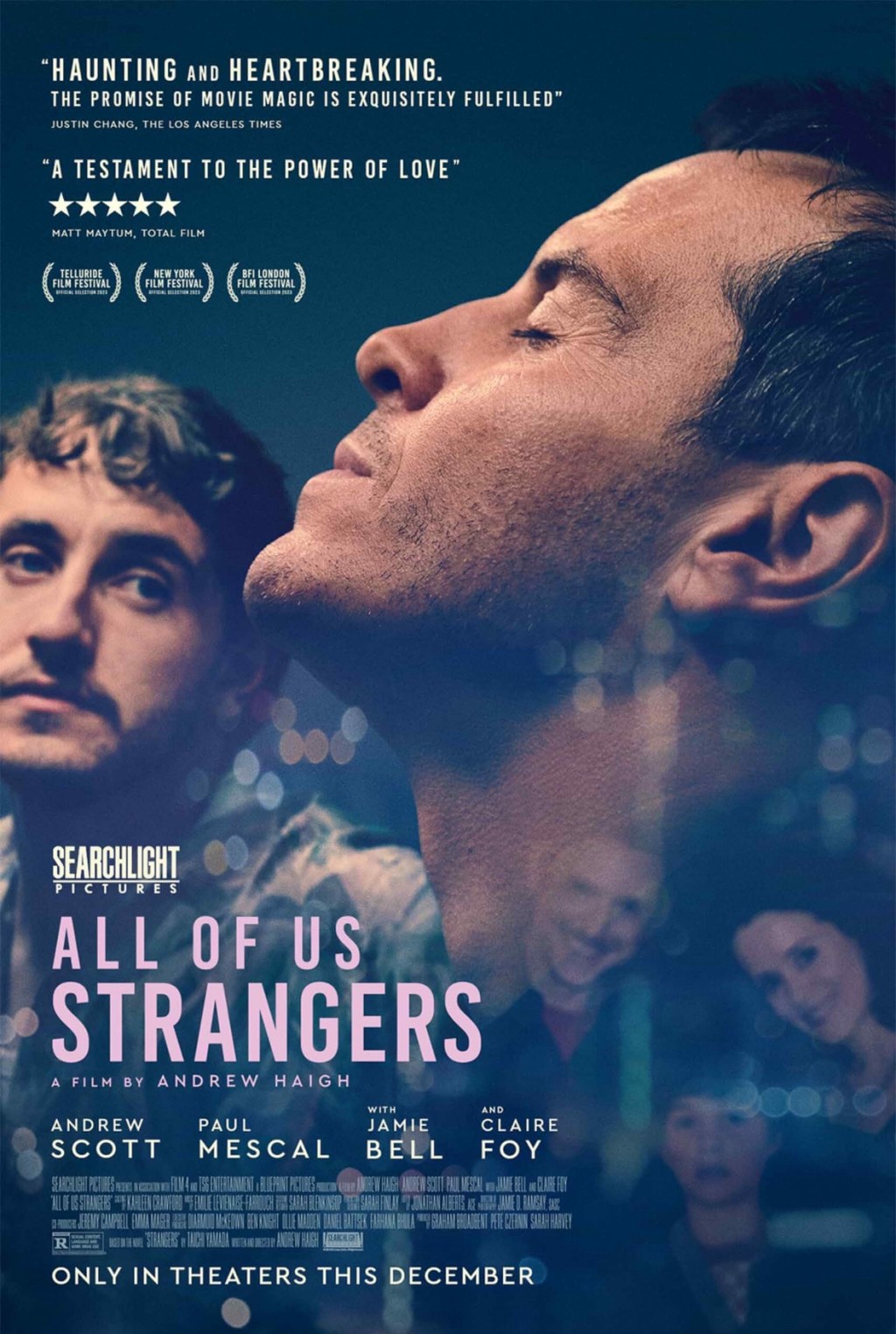
Director: Andrew Haigh
Writers: Andrew Haigh, Taichi Yamada
Stars: Andrew Scott, Paul Mescal, Carter John Grout
An aspiring screenwriter discovers upon revisiting his childhood home that he has the unique opportunity to interact with his dead parents just as they were 30 years ago…
There is an indelible quality to All of Us Strangers, one that I cannot quite seem to shake. I’ve lingered over its ideas for the past few months since I saw it, and I’ve been hard-pressed to articulate why it moves me in the way that it does.
It’s not a particularly relatable story, lest one be face to face with the ghosts of your past, musing over unobtainable writing goals whilst discovering you and your new lover may in fact be the only two souls in an entire apartment complex.
No—no. I take it back. The premise of All of Us Strangers is devastatingly relatable. The ghosts that we knew, whether they be people or the yearning for a moment—a connection—never to come to pass, is a universal desire.
The feeling of being lost, floundering through a monotonous existence with no real anchor, no clue how we got there, only to find a haven in someone whom we want to share our whole world with.
Forgetting the pressure of logic or sense, All of Us Strangers explores the deep-felt emotional binds that tether us to one another. The particular brand of melodrama here may be difficult for some.
All of Us Strangers imagines a world in which everything left unsaid can now be brought to light, and as a result, audiences may feel alienated by a script that breaks all forms of convention to extrapolate its results.
In its third act, it becomes particularly trying as it tends to break even the conventions of its already flexible world-building to allow for even more leniency in audience interpretation.
Yet, there is a noticeable truth within this premise, this challenge, that enriches the audience experience if one chooses to engage with it. The hypothesis at the center of the film seems to postulate that perhaps if we are brave enough to truly admit it, we all live with ghosts. The ghost of nostalgia that allows us to yearn for the embrace of our mothers in the middle of the night as we scamper to our parents’ bed.
The ghost of longing for our fathers to embrace us for our secrets, to love us despite the times, despite the fears of what our futures may hold. The ghost of an embrace with a loved one as we embark on a journey through an ethereal escape from reality into a world where we can just be forever, carefree and high, shrouded in a sea of strobes and starlight.
All of Us Strangers is a ghost story and through exploring a world in which the past can meet the present in a perfect harmony that blends truth and fiction. Perhaps none of it makes sense, and perhaps none of it has to so long as it feels real.
Anchored by four of the finest, most heartfelt performances of the year, All of Us Strangers manages to navigate the planes of existence in a melodrama that takes a Pollickian paint brush to all emotions and smatters them across a broad canvas.
At its very core, acting is a translation. It is a practice in presenting ideas, thoughts, and feelings, to a story and communicating them to an audience. In that practice, each of the four leads here stands head and shoulders among the finest communicators of the year, enriching our experience with a breadth of emotion rarely observed with such astonishment of heart.
Andrew Haigh crafts a menagerie of sorrow, the full ambitious showcase of grief, and lays it bare.
The truest tragedy of All of Us Strangers is that I cannot ever experience it again anew, cannot ever embark on the journey without knowing the destination because seeing stars in the night sky for now and forever more will be an experience that is intrinsically tied to this film
 Movie Burner Entertainment
Leave a comment