
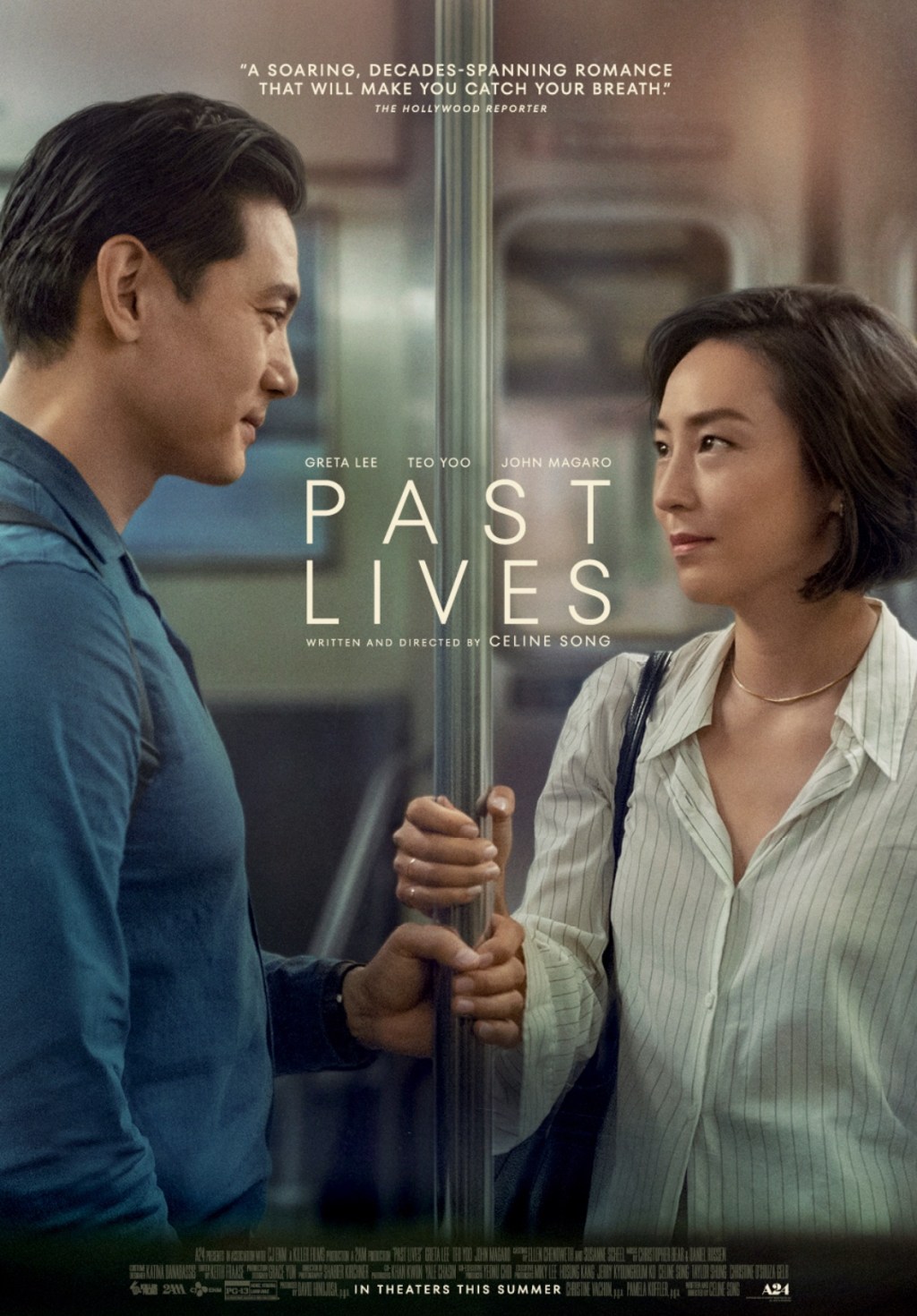
Director: Celine Song
Writer: Celine Song
Stars: Greta Lee, Teo Yoo, John Magaro
Shows the interconnecting lives of two childhood friends, Nora and Hae Sung, as they unintentionally test the boundaries of their tethered souls amidst a world that forces them to confront their understandings of love…
2023 was, to me, a year of unquantifiable hardship. It was a year that seemingly marked a collective understanding of our shared anguish. In the wake of the pandemic, it felt as though this was the first year where many of us, at least in circles that this writer finds himself in, could take stock, and what we found in the counting of our lives proved to be troubling pains that lurked in the shadows of our deepest anxieties. I—personally—felt as though this was a year of profound sadness, a feeling that could not be measured by any one specific hardship but instead felt like the culmination of years of repressed grief.
Whether it be a childhood lost to time, a friend or relative scattered to the wind, or a dream laid bare only to be washed away, this was the year that it seemed to all come to the surface. This seems an odd and lengthy introduction for a write-up on Past Lives, but a movie as deeply felt and profound as Celine Song’s poignant film requires meditation.
Past Lives is a movie meant to settle viewers into a feeling of this aforementioned collective grief, aiming to appeal not to the literal measurement of intimacy but rather to the captivating and illusive feeling of longing.
The title works not merely as a commentary on decisions made that leave important elements—often important people—behind in the lives we leave in our wake, but also as a yearning for the tethers of time to show us another thread, to allow us the opportunity to see that other path as it passes us by.
There is an unquantifiable grief that lingers over our three leads. For Nora, there lies an overwhelming sadness as the trajectory of her life forces her to rebuke a connection manifesting into an inherent guilt over her own perceived selfishness.
For Hae Sung, it is a grief of longing, the knowing that the love of your life lies just out of reach, the desperation to force two beautiful pieces of a puzzle together only to realize that the colors don’t match despite their pegs. And for Arthur, a character we meet only halfway through the picture, it is a desire to support his wife, the sure-fire love of his life, knowing that her dreams may take her to a place he cannot follow—watching helplessly as the one he loves makes an active choice to stay with him despite an emotional pull that drags her towards an unquantifiable kinship with another.
Song’s screenplay beautifully captures this deep-felt, bittersweet tragedy, rarely ever remarking on the anger of the situation, the frustration which would be so relatable and yet so tired and formulaic.
Instead, Song subverts the expectations of her audience and insists instead that love can prove more powerful. Nora’s husband has every right to storm and fuss and rant and rave and bemoans his ostracized position in this uncomfortable love triangle, but instead, Arthur appears as an earnest observer.
He attempts to learn Korean to provide a more stable middle-ground for his wife and former best friend, but—more to the point—he longs to understand the facets of her mind grounded in Korean, to wander into the machinations of her thoughts and to understand them as more than a mere translation.
There is an intimacy in these characters’ wants that seldom gets broached in even the most nuanced of dramas. There is often more heart in a single line uttered by one of these three than most films could have in an entire runtime.
It’s often elusive to me how we love in the way that we do. I hem and haw about love being a choice, a promise you make over and over, versus an intrinsic value, a thing as natural as breathing that happens organically with no rhyme or reason.
Surely, I’ve felt both. I’ve endured Nora’s silent walk of thoughtfulness trying to piece together the paths that lead to such a feeling of taxation on my soul. The line I continuously come back to in Past Lives is one that Hae Sung says to Nora. He tells her, “I love you because you are you. And you are someone who leaves.”
Song doesn’t have her characters waste time in trying to rant and rave around their articulate points. She strikes with precision, each line of her script proving the conceit of her thesis: that love, whether it is a choice or not, exists, and in this existence, we must grow to accept that it envelops us in ways beyond our comprehension.
The best we can do is be waiting on the steps ready to embrace our loved ones when they cross paths with love’s enigmatic desires.


 Movie Burner Entertainment
Leave a comment