
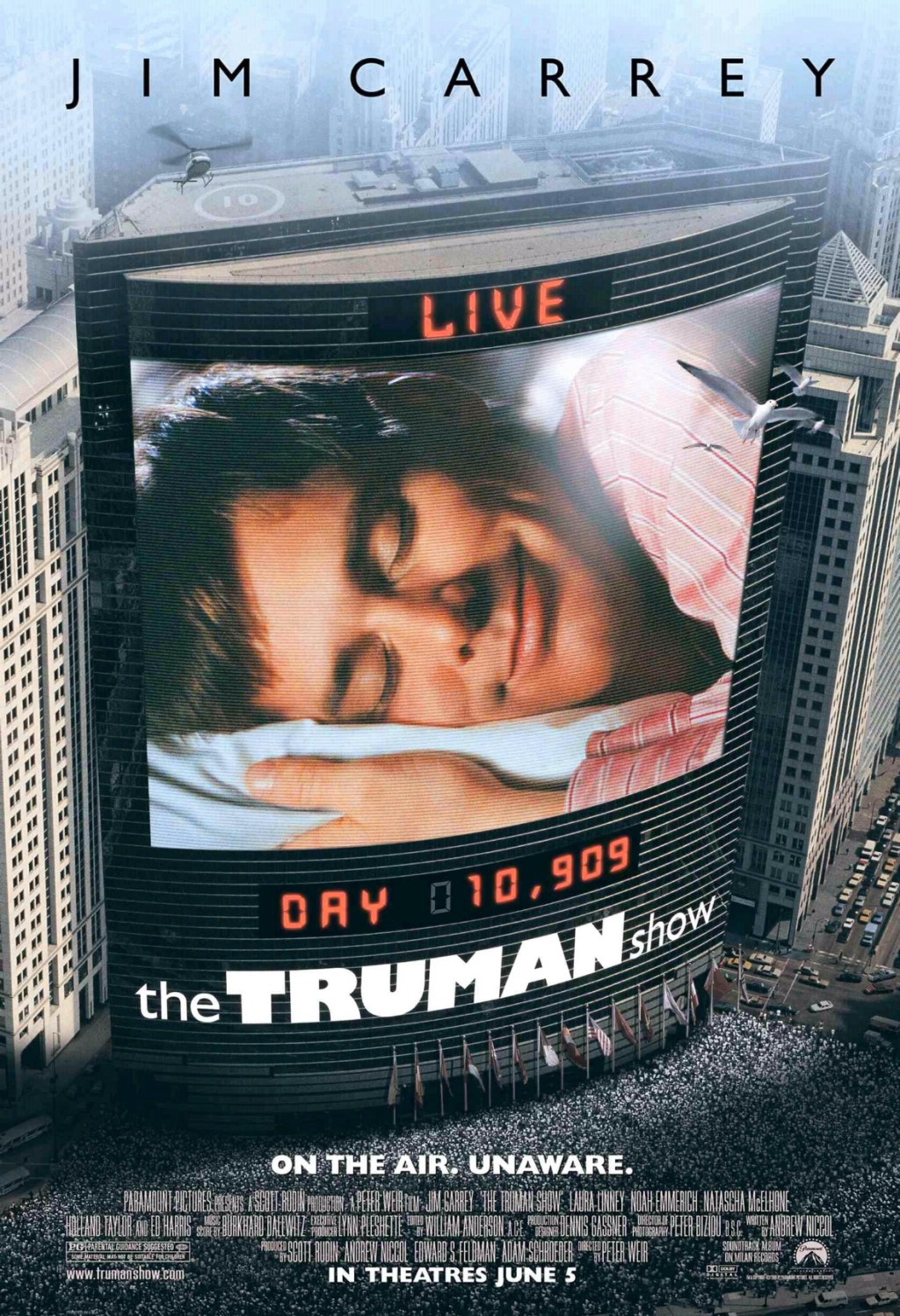
Director: Peter Weir
Writer: Andrew Niccol
Stars: Jim Carrey, Ed Harris, Laura Linney
“The Truman Show,” directed by Peter Weir and starring Jim Carrey and Ed Harris, is a cinematic masterpiece that combines satire, drama, and thought-provoking commentary on the nature of reality and media. Released in 1998, the film remains relevant today for its insightful critique of voyeurism, consumerism, and the human desire for authenticity.
Peter Weir’s direction is instrumental in creating the film’s unique atmosphere. Weir, known for his work on “Dead Poets Society” and “Witness,” brings a nuanced approach to “The Truman Show.” His direction balances the film’s satirical and dramatic elements, ensuring that the story remains engaging without being preachy. Weir’s ability to blend humor with profound philosophical questions allows the film to resonate on multiple levels.
The cinematography by Peter Biziou is another standout element. The film is shot in a way that mimics reality television, using hidden cameras and unconventional angles to create a sense of surveillance. This approach not only enhances the narrative but also immerses the audience in Truman’s world. The idyllic setting of Seahaven, with its pastel-colored houses and manicured lawns, contrasts sharply with the underlying artificiality of Truman’s existence.
Andrew Niccol’s screenplay is the backbone of “The Truman Show.” Niccol, who also wrote “Gattaca,” crafts a story that is both original and thought-provoking. The screenplay’s strength lies in its ability to weave together various themes seamlessly. It explores the ethics of reality television, the manipulation of media, and the existential quest for truth. Niccol’s writing is sharp and incisive, filled with memorable lines and moments that linger long after the credits roll.
The film delves into several complex themes. It critiques the intrusive nature of media and questions the morality of turning someone’s life into entertainment. Truman’s journey towards self-discovery and freedom serves as a powerful allegory for the human condition. The film also touches on issues of privacy, consent, and the authenticity of relationships in a media-saturated world.
Jim Carrey delivers a career-defining performance as Truman Burbank. Known primarily for his comedic roles in films like “Ace Ventura” and “The Mask,” Carrey showcases his dramatic chops in “The Truman Show.” His portrayal of Truman is heartfelt and nuanced, capturing the character’s innocence, confusion, and eventual determination to break free. Carrey’s ability to convey a wide range of emotions adds depth to Truman’s character, making his journey relatable and compelling.
Ed Harris’s portrayal of Christof, the creator of the Truman Show, is equally impressive. Harris brings a quiet intensity to the role, embodying the god-like figure who manipulates Truman’s world. His performance adds a layer of complexity to the character, making Christof both a visionary and a villain. Harris’s interactions with Carrey’s Truman are particularly gripping, highlighting the power dynamics at play.
The supporting cast, including Laura Linney as Meryl Burbank and Noah Emmerich as Marlon, also deliver strong performances. Linney’s portrayal of Truman’s scripted wife is both unsettling and tragic, while Emmerich’s role as Truman’s best friend adds emotional weight to the story. The ensemble cast works together seamlessly, enhancing the film’s exploration of authenticity and deception.
The pacing of “The Truman Show” is expertly managed, gradually building tension as Truman begins to suspect the truth about his world. The film’s structure, which alternates between Truman’s perspective and the control room of the Truman Show, keeps the audience engaged and invested in the unfolding mystery. This dual narrative approach allows the film to explore both the personal and societal implications of Truman’s situation.
The film’s music, composed by Burkhard Dallwitz and Philip Glass, complements the narrative beautifully. The score ranges from whimsical to haunting, reflecting Truman’s emotional journey. The sound design also plays a crucial role in creating the film’s atmosphere, using ambient noises and the occasional silence to heighten the sense of surveillance and control.
The visual effects in “The Truman Show” are subtle but effective. The film relies more on practical effects and set design to create the illusion of Seahaven rather than heavy CGI. This choice enhances the film’s realistic yet surreal aesthetic, making Truman’s realization of his constructed reality even more impactful.
“The Truman Show” is a timeless film that continues to resonate with audiences. Its insightful critique of media manipulation and its exploration of existential themes make it a standout in the realm of satirical drama. Peter Weir’s direction, Andrew Niccol’s screenplay, and the stellar performances by Jim Carrey, Ed Harris, and the supporting cast come together to create a film that is both entertaining and thought-provoking. “The Truman Show” is not just a film about a man discovering the truth about his life; it is a profound commentary on the human condition and the search for authenticity in an increasingly artificial world.

 Movie Burner Entertainment
Leave a comment