
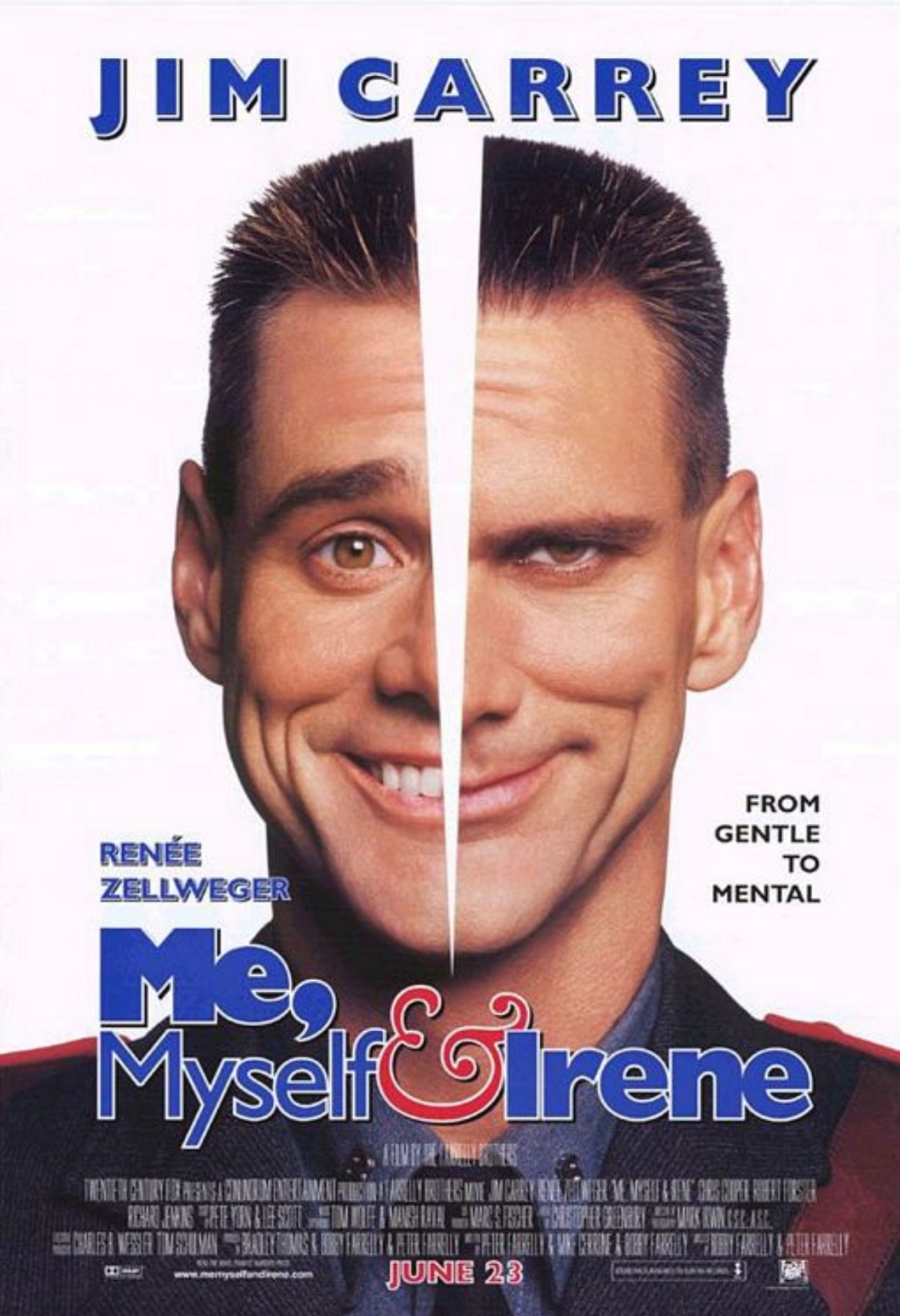
Directors: Bobby Farrelly, Peter Farrelly
Writers: Peter Farrelly, Mike Cerronez, Bobby Farrelly
Stars: Jim Carrey, Renée Zellweger, Anthony Anderson
“Me, Myself & Irene” is a 2000 American dark comedy film directed by the Farrelly brothers and starring Jim Carrey. Known for their distinct blend of humor and heartfelt storytelling, the Farrelly brothers once again collaborate with Carrey, aiming to recreate the magic of their previous success, “Dumb and Dumber.” This review delves into various aspects of the film, including its production, writing, acting, and overall execution.
The Farrelly brothers, Peter and Bobby, are no strangers to the world of comedy. By 2000, they had already established a reputation for their unique brand of humor, which often balances on the edge of absurdity and sentimentality. “Me, Myself & Irene” was produced by 20th Century Fox, with a budget estimated at $51 million. The production spanned various locations, including Rhode Island and Vermont, capturing picturesque landscapes that juxtapose the film’s chaotic narrative.
The Farrelly brothers’ collaboration with Jim Carrey was a significant highlight of the production. Carrey, already a comedic heavyweight by this time, brought his physical comedy and expressive facial antics to the table, making the film a visual treat. The production phase also saw meticulous planning of stunt sequences and special effects, essential for portraying Carrey’s dual personality disorder.
The screenplay, penned by the Farrelly brothers along with Mike Cerrone, weaves a narrative that is both outrageous and surprisingly tender. The story revolves around Charlie Baileygates (Jim Carrey), a mild-mannered Rhode Island state trooper who develops a split personality disorder after years of suppressing his frustrations. His alter ego, Hank, is everything Charlie is not—aggressive, rude, and uninhibited.
The writing cleverly explores themes of identity and self-acceptance through the lens of comedy. The plot’s progression is marked by a series of escalating absurdities, from Charlie’s outlandish coping mechanisms to Hank’s unruly antics. Despite its comedic veneer, the screenplay delves into deeper issues such as mental health and resilience. The dialogues are peppered with witty one-liners and slapstick humor, characteristic of the Farrelly brothers’ style.
Jim Carrey’s performance is the cornerstone of “Me, Myself & Irene.” His ability to seamlessly switch between the timid Charlie and the boisterous Hank is a testament to his versatility as an actor. Carrey’s physical comedy is on full display, with exaggerated facial expressions and body language that heighten the film’s comedic elements. His portrayal of Charlie’s struggle with his identity and his eventual confrontation with Hank adds a layer of depth to the otherwise light-hearted narrative.
Renée Zellweger plays Irene Waters, the love interest who becomes entangled in Charlie’s chaotic life. Zellweger’s performance is both charming and grounded, providing a steady counterbalance to Carrey’s manic energy. The chemistry between Carrey and Zellweger is palpable, adding a romantic subplot that enriches the film’s emotional texture.
The supporting cast includes Chris Cooper as the villainous Dickie Thurman, Robert Forster as Colonel Partington, and Richard Jenkins as Agent Boshane. Each actor brings a unique flavor to the film, contributing to its eclectic mix of characters. The inclusion of Anthony Anderson, Mongo Brownlee, and Jerod Mixon as Charlie’s adopted sons adds further diversity and humor to the narrative.
“Me, Myself & Irene” is executed with the Farrelly brothers’ trademark blend of crude humour and heartfelt moments. The film’s pacing is brisk, ensuring that the audience remains engaged despite the sometimes outrageous plot twists. The directors’ use of visual comedy complements the script’s verbal humour, creating a dynamic viewing experience.
The film’s cinematography, handled by Mark Irwin, captures the picturesque settings of New England, providing a scenic backdrop to the unfolding madness. The editing by Christopher Greenbury and Debra Neil-Fisher is sharp, maintaining a rhythm that aligns with the film’s comedic timing.
The musical score, composed by Lee Scott and Pete Yorn, features a mix of rock and pop tracks that enhance the film’s energetic vibe. Notably, the soundtrack includes Steely Dan’s “Reelin’ In The Years” and Foo Fighters’ “Breakout,” which underscore key moments in the narrative.
“Me, Myself & Irene” is a quintessential Farrelly brothers’ comedy that leverages Jim Carrey’s comedic prowess to deliver a film that is both hilarious and unexpectedly poignant. While the film’s humour may not appeal to all tastes, its exploration of identity and self-acceptance provides a thoughtful undercurrent to the slapstick exterior. The strong performances, particularly by Carrey and Zellweger, coupled with the Farrelly brothers’ adept direction, make “Me, Myself & Irene” a memorable entry in the comedy genre.
In essence, the film stands as a testament to the collaborative genius of the Farrelly brothers and Jim Carrey, offering a comedic yet heartfelt narrative that continues to resonate with audiences even decades after its release.
 Movie Burner Entertainment
Leave a comment