
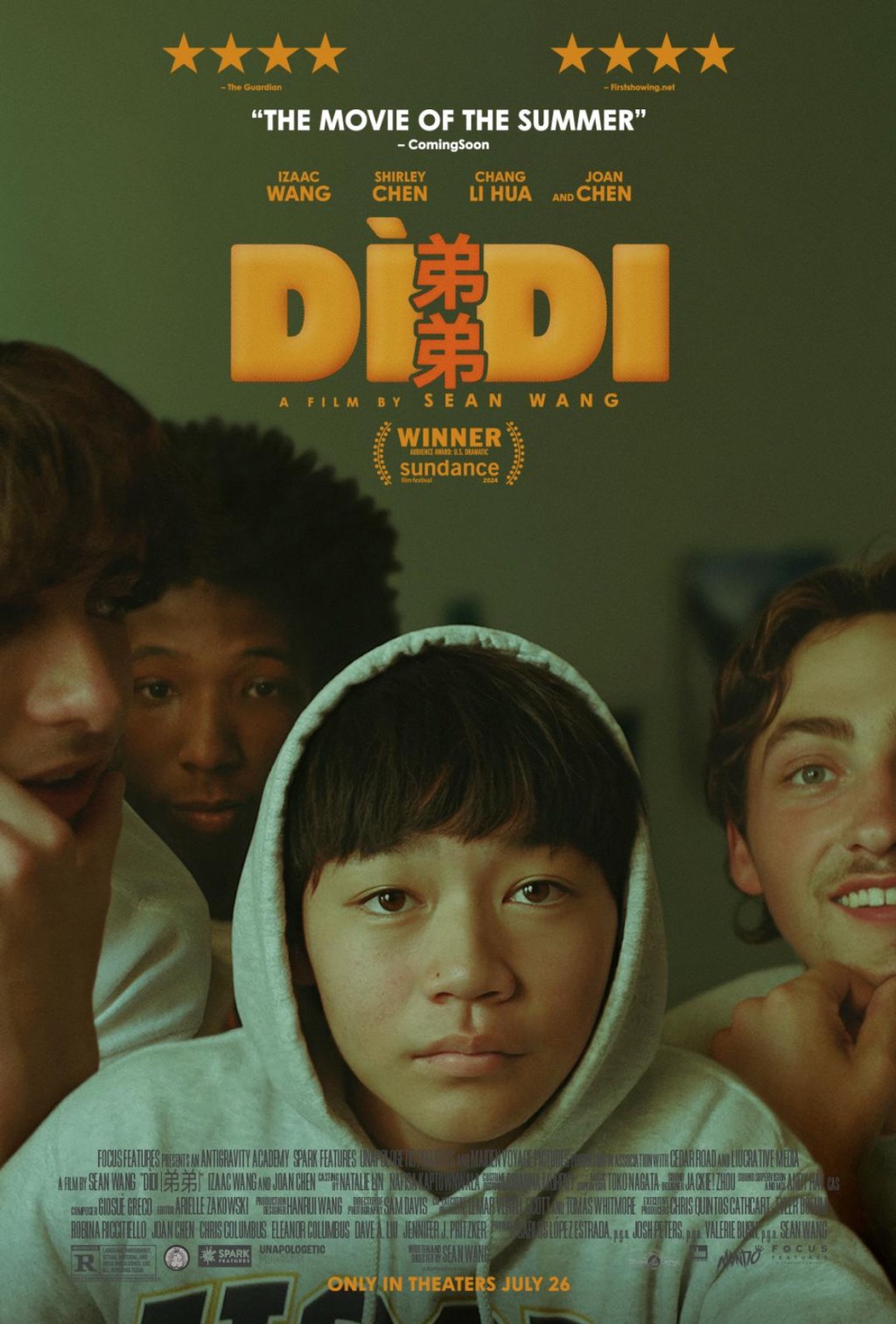
A snapshot of the summer between 8th and 9th grade as young Chris must navigate the pressures of change in the evolving world of 2008…
It’s almost difficult for me to write about Didi on account of its uncanny accuracy in relaying to me a thoroughly detailed exploration of my own life. There’s a journalistic accuracy to the approach that is discomforting watching as a young, creative adolescent transitions into high school while overcoming the pressures of teenage angst, the dawn of Facebook and AIM, the social anxieties of making new friends and keeping old ones.
Chris isn’t merely relatable because of his circumstances (though it is also unnerving for me watching his enemies-to-friends relationship play out with his older sister just as she leaves for college, an exact replica of my relationship with my own older brother complete with an identical age differential) but also because of how Chris deals with these pressures.
The social self-implosion manifesting into a depressive state of isolation and loneliness could have been lifted directly out of my own 8th grade journal. That said, there is a fair bit more to glean from Didi than my own circumstantial connection.
This is a story about Asian American identity, demonstrating several customs and generational points of view that deepen Chris’s isolation as he struggles to find his personal identity. But there is a universality to that uncertainty that only masterful filmmakers at their most vulnerable, their most honest, can seem to achieve.
Didi is an often hilarious movie demonstrating the reckless abandonment of youth as it’s carefully siphoned out through the recognition of age. Chris has juvenile passions, but they are passions nonetheless.
The drive to suddenly make something of them catapults him towards circumstances that on the surface seem precarious, but Sean Wang’s expert script always manages to walk the tightrope of danger and fun to allow for a more precise reality to overlay the film. It’s a movie where, like youth in real life, there’s always a threat of something truly awful happening, but the real pain and trauma can be derived simply from growing up in this gradual state of complex uncertainty.
The lovely assembly of this ensemble cast drags in a variety of different adolescent socialites each at varying levels of confidence to draw direct comparisons back to Chris as he struggles with his own identity, but it is Joan Chen who comes away with the star making performance.
As Chris’s mom, she fights with a tender care to connect to her children who seem insistent on running away. Chen’s performance is staggering in its quiet moments as she glances toward the uncertain future of her own life in tandem with her kids, yearning to simply fix the pain that the world inflicts so naturally with its cruelty but knowing she is powerless to do so, knowing that she can only be a mother and praying that can be enough.
Didi is a slice of life picture. It’s insistence on leaving threads open ended to leave room for Chris’s real future may leave its audience feeling more like they read the first book in a promising series than completing the journey of a cinematic film. There’s a deliberate dissatisfaction to the resolution, but if the film’s biggest flaw is that it ended, then I’d surmise that it was a pretty excellent film. 9.3/10



 Movie Burner Entertainment
Leave a comment