
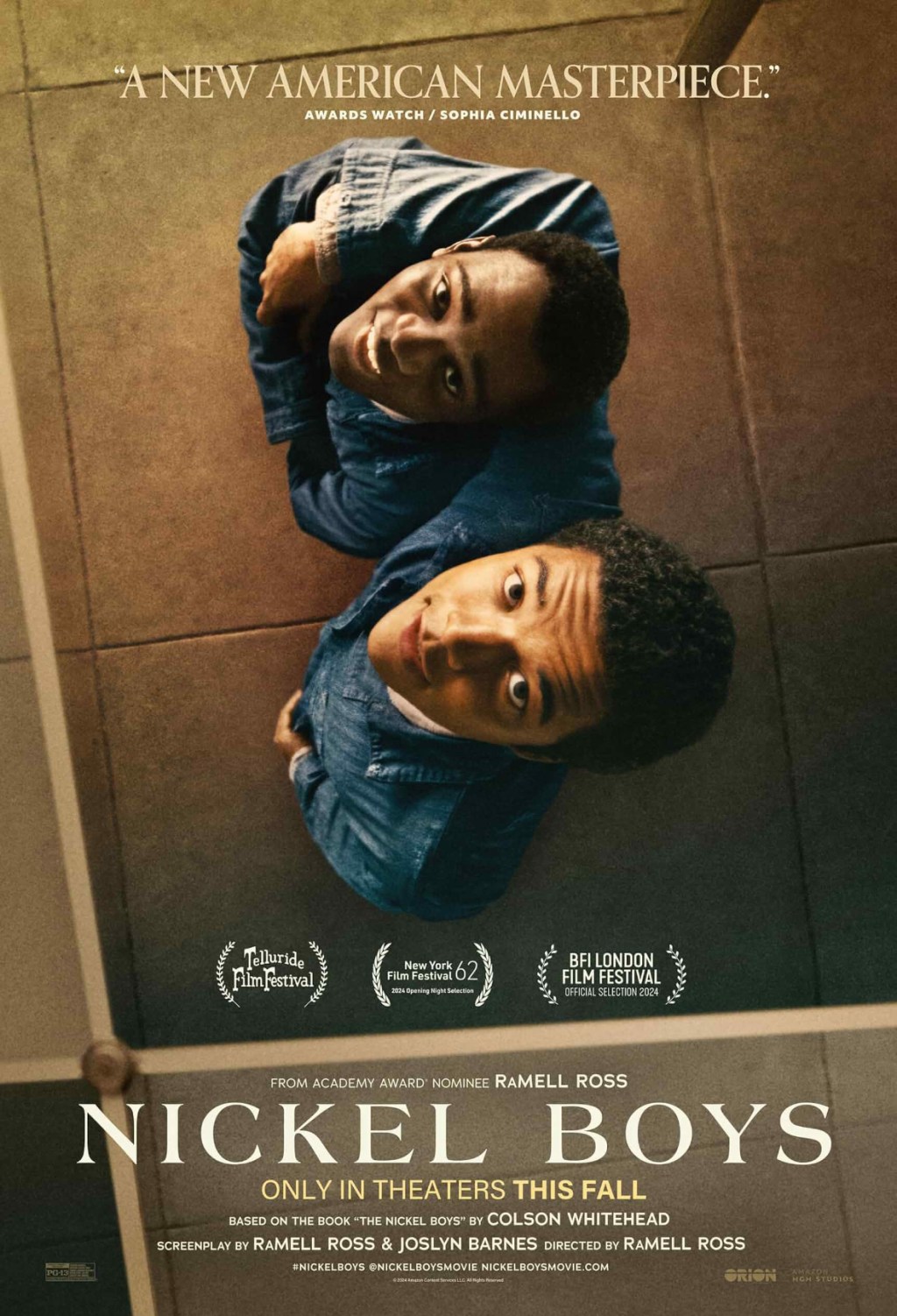
A friendship between two African-American boys as they’re forced through isolation and racist oppression in the pressurized environment of a reform school, Nickel Academy…
There’s a version of Nickel Boys that exists in another universe made by another director that still manages to stir the hearts of its viewers, but in this adaptation of Colson Whitehead’s award winning novel, Ramell Ross’s directorial flourish makes for one of the most visually arresting pictures of the year.
The choice to shoot the film primarily in first-person (and by some extension, an argument could be made that it is inadvertently second-person as well) is a bold stroke that could easily deter narrative intrigue. Indeed, in the first act of the film, the stylistic choice almost feels self-indulgent, too ambitious for its own good, as audiences may find themselves uncomfortable or hesitant to buy in, worried that Ross’s vision can’t justify its aesthetic choice.
This is a remarkably faithful adaption, one that’s best left unspoiled as it re-contextualizes itself with each delicate moment, but it demands to be said that upon the film’s conclusion, once this directorial choice earns its narrative justification as if to say our trauma removes us from the inner workings of ourselves, forces us into a perpetual state of dissociation, there is simply no doubt that the directorial ambition pays off.
There’s a delicate quality to Nickel Boys, or as Ross describes it, ‘the epic banal,’ the idea that our lives consist of moments that feel precious in our desire to preserve the simplicity of them. The epic banality of riding the bus or seeing the lights that pepper a street around Christmas time.
The epic banality of a hug. The epic banality of watching paint dry. Nickel Boysis a movie so adorned in tragedy but so wisely showing us the moments we should be grateful for instead. It refuses to linger on the torment and trusts instead that our lives will do enough of that for us. Instead it shows us a series of attempts at life reaching back through the camera to grace us with the opportunity to appreciate something deeper.
I feel like a broken record in making yet another declaration for Aunanue Ellis-Taylor to win an Oscar as she manages to ground this film so effortlessly. Ellis-Taylor is transportive taking the audience with her as she fights to connect with them. Her motherly presence acts as the guiding light, the beacon that the character’s—and by association, the audience—strive towards.
Nickel Boys is a somber, quiet triumph of a movie. It’s a film that is precious with its source material adding an audacious lens to this pristine story in an effort to heighten its emotional intent. It’s a traumatic film, one that is likely to awaken deep feelings in its viewers. And for that, I am grateful it exists. 9/10



 Movie Burner Entertainment
Leave a comment