
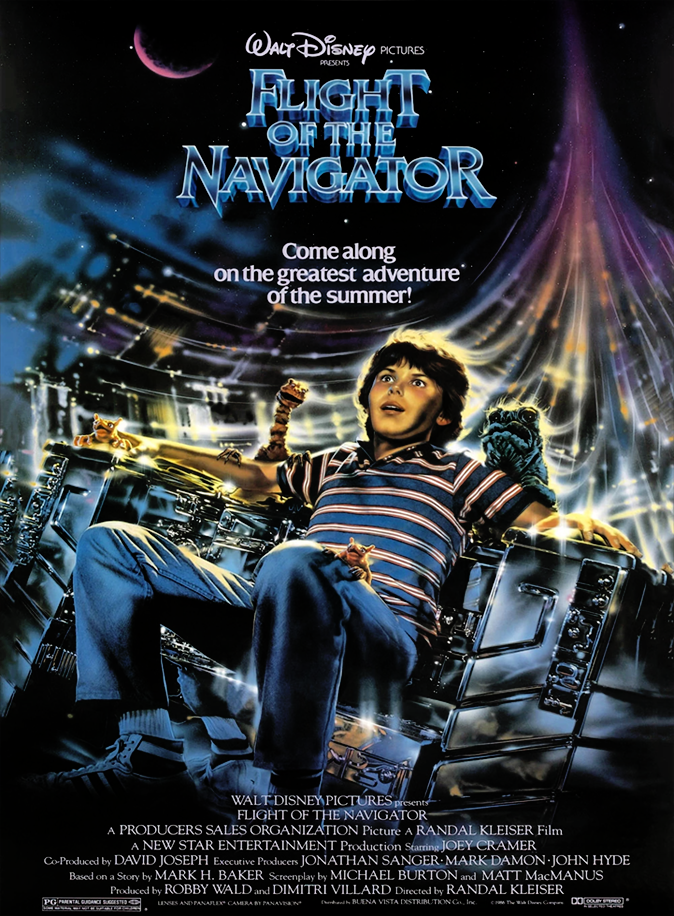
Director: Randal Kleiser
Writers: Mark H. Baker (story), Michael Burton (screenplay)
Stars: Joey Cramer, Paul Reubens, Cliff De Young, Veronica Cartwright, Sarah Jessica Parker, Matt Adler, Howard Hesseman
Let’s set the time machine back to the days of VHS rentals, a nostalgic era I cherish. It was my ever-considerate Gran who introduced me to the wonders of “Flight Of The Navigator.” I must have borrowed that VHS tape a dozen times, my 10-year-old self utterly fascinated by the concept of time and space. This was an age when “Back to the Future” had just graced the screens (the best time travel film ever, according to my humble opinion), making it a daunting task for Disney, who had, interestingly, passed on “BTTF,” to compete or surpass the classic duo of Michael J. Fox and Christopher Lloyd. However, “Flight of the Navigator” had a unique backstory of its own. Originally intended as an independent film, Disney later secured the rights and infused their financial magic into the project, ensuring its release.
The movie kicks off in 1978 at a Frisbee Competition (that ’70s touch), and Director Randal Kleiser immediately starts playing tricks on the audience. He lures us into spotting flying saucers in the form of silvery Frisbees against the backdrop of a cityscape. We are teased again as the crowd reacts to an “aircraft” flying overhead, which, upon closer inspection, turns out to be a mere hot air balloon. As we’re introduced to the Freeman family, including young David played by Joey Cramer, it all appears typical for an American family planning to celebrate the 4th of July.
However, the story takes a sharp turn as the Freeman brothers, David and Jeff, display their classic older-younger brother dynamic. With teasing and bickering, they head home from the Frisbee Championships. Jeff is dropped off to play with friends, while David, dealing with typical 12-year-old boy girl trouble, returns home to face a dilemma. His mother asks him to pick up Jeff from the neighbors, a mile away through the woods, and that’s when the adventure truly begins.
David’s nighttime journey through the woods takes a chilling twist when he encounters an eerie old lady who claims his family’s house as her own. Bewildered and frightened, David forces his way into the house, which is significantly different from the one he left only hours ago. To his shock, there’s no sign of his family, and the audience is left as baffled as the film’s protagonist.
Kleiser’s genius shines in the opening 15 to 20 minutes of the movie, setting the stage with a compelling portrayal of two closely connected yet distinct time periods. The fashion and attitudes of the ’70s and ’80s are highlighted with charm, and even though the ’80s sensibilities are inescapable, there are subtle touches that make these two eras come to life. David’s mysterious absence for 8 years and his subsequent return are meant to be emotional, but they turn out to be more unsettling due to the eerie makeup and prosthetics that transform his parents. Even their dog, bruiser, turns into a nightmare with its almost albino-like eyes.
Now, the science bit. As David is hospitalized, he discovers that he hasn’t aged in the eight-year gap between 1978 and 1986. The tests reveal some puzzling results, including images resembling a ship or cocoon. Enter Dr. Louis Faraday, portrayed by Howard Hesseman, and his NASA team, who discover an unidentified flying saucer that oddly resembles the images in David’s mind. The pieces of the puzzle start coming together, linking David’s situation to a strange discovery, and he’s whisked away to NASA for further tests. There, he forms a friendly relationship with Carolyn McAdams, played by Sarah Jessica Parker, a connection that subtly portrays David’s growth in his ability to interact with girls. The movie skillfully maneuvers the cat-and-mouse game between David, Max, the ship’s computer voiced by Paul Reubens (masquerading under the name Paul Mall), and Dr. Faraday. David, desperate to return home, faces a dilemma, as Max explains the potential risks of his voyage back to 1978.
In conclusion, “Flight of the Navigator” had the potential to be an independent film, but Disney’s involvement ensured its place in cinema history. Sure, it has some Disneyfied moments and moments that could be considered cheesy, even by 1986 standards. But on my initial viewing as a kid, this film had enough to pique my curiosity, and it still serves as a nostalgic trip down memory lane. For its time, the movie was visually stunning, especially the design of the liquid metal steps on the ship and the chrome interior. Joey Cramer’s performance was commendable in the lead role, although he has faced personal challenges over the years. Notably, a documentary called “After the Navigator” is set to be released next year, and it might shed some light on the film’s legacy. If you haven’t seen it, give “Flight of the Navigator” a shot. It’s an entertaining journey through time and space, and it comes recommended for a pleasant movie night.




 Movie Burner Entertainment
Leave a comment