

It’s been six years of writing for the Movie Burners. Six years of Top Ten lists, and six years of being unendingly supported by the people who make up this site.
MovieBurnerEntertainment.Org was the first site to ever publish my written work, and the first people to ever allow me to say ‘I am a writer’, and for that, I will forever be grateful. If you read this list, whether this is your first time reading my year’s end or the sixth, I am grateful to you as well.
What to expect:
This is a list of my Top Ten Favorite Films of 2023. I have a philosophy that there is a certain sense of objectivity in criticism that all critics should aim for. Because of this philosophy, I tend to consider that something I recognize as ‘the best’ does not always necessarily constitute ‘my favorite’. You will see an eclectic list counting down from 10-1. For each film, I have taken the time to try to best articulate what I enjoyed about it, as well as a brief mention of criticism trying to capture a sense of that aforementioned objectivity.
I score each film on a 100-point scale. It is a pretentious ranking system, but I am nothing if not a pretentious little writer. You’ll surely notice that some films will have higher scores on that 100-point scale despite being lower on the list. This is by design in the hopes that we can capture some of that objectivity. But if you disagree with the philosophy, it’s perfectly fine to simply ignore the scores. If a film made this list, I wholeheartedly endorse it, so a score matters hardly at all. No matter what, I just hope you enjoy the journey.
The write-ups are something I work very hard on, and though they don’t intentionally contain spoilers, I would certainly say that the context within them is likely better appreciated if you have seen the films through to completion before reading. Whether or not you read these blurbs before watching these films I leave it to your own personal discretion.
There will be run-on sentences, poor use of commas, and all sorts of linguistic rules broken. There will be first-person writing, second-person writing, and all the bad writing you could imagine. But I hope that these write-ups can at least capture the heart of what made these movies so special to me. Maybe they will articulate what makes them special to you too.
The List
As is customary, I like to begin with a few honorable mentions. While I have seen a lot of films this year, I haven’t seen every film. If some notable entries are missing (for example, I have not yet seen The Color Purple, American Fiction, or Priscilla to name a few), you’ll have to forgive me. I often joke that in the days immediately after this list’s release, I always find a Top Ten film. But with time constraints being what they are, I still feel confident in this list.
Now, back to honorable mentions. I adored these movies and still endorse that you see them, but the ten films that made the list I enjoyed just a hair more. In no particular order, these honorable mentions are…
Spider-Man: Across the Spider-Verse (a film that surely would have been a Top Ten if only it didn’t end on the most egregious cliffhanger in cinematic history)
Killers of the Flower Moon (Another award-worthy Scorsese epic with harrowing themes that deserve detailed examination)
The Killer (Fincher’s technical brilliance on full display in a comedy of errors that presents itself as a thriller)
The Iron Claw (Zac Efron hive, rise up)
Are You There God? It’s Me, Margaret. (Rachel McAdams hive, rise up)
Now, let’s begin.
- Barbie
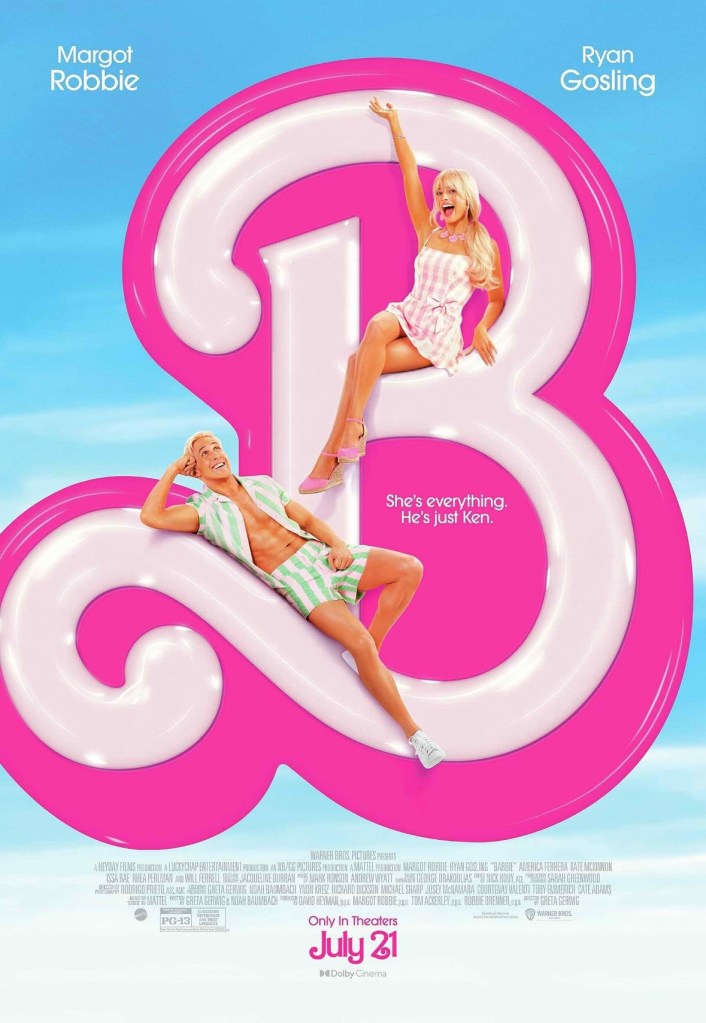
A popular children’s doll begins to suffer an existential crisis that leads her into reality and forces her to confront the meaning of existence and womanhood…
A Top Ten Of The Year List would simply not feel complete without the inclusion of Greta Gerwig, a director whose work as a sterling auteur has become a beacon of joyous wonderment through wonderful, fully realized characters. With her longtime partner (and now husband) Noah Baumbach assisting with the script, Gerwig crafts a surprisingly silly story complete with all the machinations of a satirical sketch comedy.
Our heroine and titular character lives an ideal existence moving through the monotony of moments and motioning through a stunning environment (utilizing sublime production design that meshes with the perfect modicum of visual effects to provide maximum hilarity and intrigue). Barbie’s infectious smile beams as she saunters through the carefree world, dancing and greeting her friends to her heart’s content only to discover that she may have a tiny grain of thought that threatens to cripple the very idealistic world that she lives in.
Lo and behold, Barbie’s journey begins as she is faced with a crippling existential crisis that forces her to journey into the real world and face the often sinister reflections of humans who have very different understandings of idealistic circumstances. Barbie’s journey is made all the more poignant by her side-kick Ken, played to a punctual perfection by Ryan Gosling.
Ken embarks on the journey with rose-tinted glasses of his own ready to completely revitalize his very existence through a fundamental misunderstanding (or perhaps a darkly comedic understanding depending on your outlook) of the way the real world works. Through all of this adventuring, our cast of characters expands to incorporate a disillusioned teen, a yearning mother, and a corporation dead-set on maintaining a status quo and forcing Barbie back into her idealistic lifestyle.
Barbie is a stunning film, not simply in its stylish joviality but also in its astonishing contextualization of the deeper fundamental principles of life. The things that a toy can represent breach far beyond nostalgia, and capturing that iconography can be an uphill task for any artist, even one as richly complex as Gerwig. What Barbie provides to the cinematic landscape should not be brushed over.
How many films this ambitious are left half-finished in the wastebaskets of other writers? Barbie is audacious. It shoots for thematic connections in the zaniest way possible. It provides a world where a literal dance fight on an ethereal plane of existence can be a battle for the patriarchal takeover of the world.
It provides a world in which the revolution of ideals can exist simply in the heartfelt sharing of the female experience. It provides a world in which mothers and daughters can share a unique understanding of ambition through a nostalgic lens of generational sacrifice, where a passed-down toy can be a reflection of years of altruistic nurturing and yearning for the future.
All of this while smothering the audience in a joyous world of pink and horse jokes and gynecology questions makes Barbie one of the most ambitious films not just of this year but perhaps the last several.
Certainly, much can be said for a commercialized product hypocritically imposing its anticapitalist views. Some can be said as well of its tones being too widespread, too far-reaching, to ever congruently fit together (indeed, our anticapitalist chase sequence with its buffoonery choreography doesn’t quite live in the same world as the Billy Eilish accompanied somber revelations at the film’s end).
But Barbie is a hallmark of the year not because of its reserved nature, but because of its bombast, and for its exuberance, I believe it should be celebrated. 8.5/10
- Air
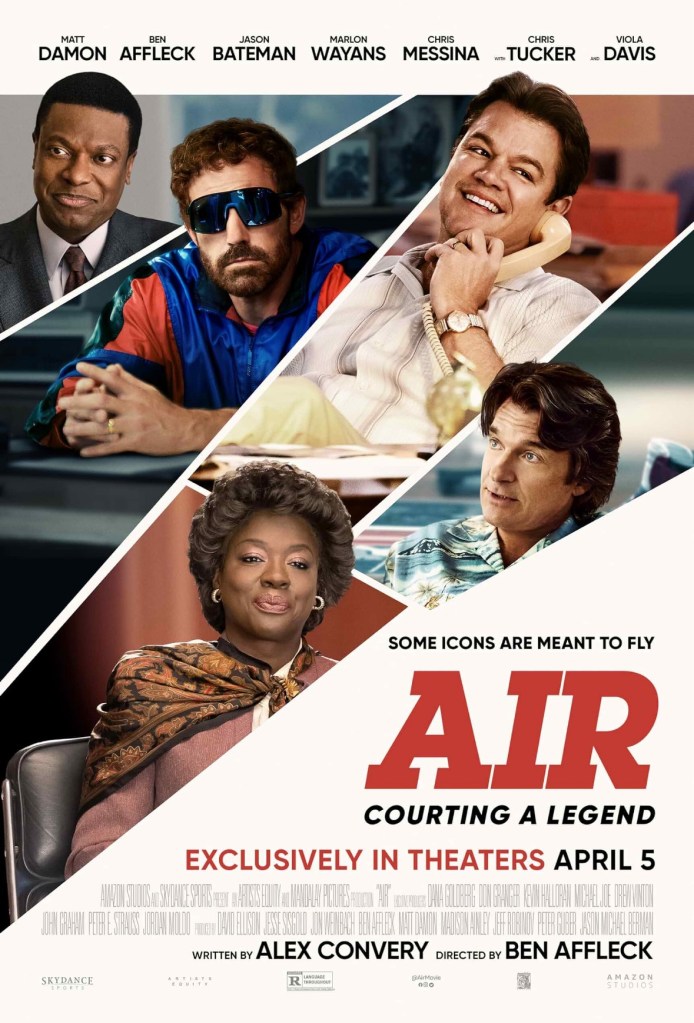
The story of a Nike sports marketing executive as he challenges the institution of his employers to sign an exclusive sneaker contract with upcoming rookie Michael Jordan…
In this writer’s humble opinion, the laziest critique one could give a film would be to say, “It’s predictable.” Predictability is hardly a metric for criticism. There is no doubt in my mind that Frodo will succeed on this journey to Mordor. Rocky will go the distance. The Kranks will find compassion and re-discover the meaning of Christmas. Why would we rewatch movies knowing full well their destination if we were worried about predictability?
Now, I know what you’re thinking: why would a review about Ben Affleck’s Air, the story of Michael Jordan’s Nike deal, draw such staunch comparisons to The Fellowship of the Ring? An insurmountable task requiring an eclectic cast of characters united—through different motivations—in defeating forces of unassailable power isn’t enough to draw a comparison? Fine. I suppose the comparison does get flimsy in comparing Converse to Sauron, but—in sincerity—the true comparison lies in the conceit of predictability.
There is nothing to spoil in Air’s endgame that anyone living in the modern age would not already assume. Michael Jordan’s signature shoe still hails as one of the hallmarks of capitalistic achievement today. But any cinema fan knows full well that knowing the destination only enriches the journey if the adventure is a story worth telling.
Air takes Alex Convery’s script full of complex, studious characters who want nothing more than to make something of themselves through a shared love of basketball, and makes each of them triumphantly appeal to the creative hearts in all of us with the same elevation of passion that one would find in a sports film.
In fact, Air has more in common with a sports film structure than most modern sports films, complete with the ‘I believe in this idea’ scene of Sonny Vaccaro showing a tape over and over again advocating for essentially an Easter egg that—to him—proves that Michael Jordan will be one of the greatest players to have ever lived. In this way, Air’s script is so excellent that it actually uses predictability to its advantage by influencing the audience’s trust in the protagonist since we fully know he’s right. Can Air get lost in its own pretension?
Sure. Plenty of moments attempt to convey a sense of awe as they hammer heavily on beats and contrive emotional impact for the audience whereas restraint tends to be far more effective. But Affleck’s direction still manages to craft an intimate setting that allows Nike to feel wholly relatable to any modern office. Through subtle yet clever production design, Nike immediately emerges as a down-and-out shoe company.
Read that sentence again. Nike. Down-and-out. Affleck’s restraint in not playing the end at the beginning allows the journey to feel much sweeter, much more triumphant, and much more honest. And that’s to say nothing of Affleck’s supporting turn as Phil Knight, an eccentric, purple-obsessed millionaire. Upon meeting Knight, he seems as though he’s aware that he’s on the back-nine, that the ‘great ideas’ that once made Nike are now in the rearview.
He advocates for a sense of normalcy, of complacency. But once Vacarro ignites the office with a sense of hope, Knight grows from begrudgingly nervous to an emphatic champion of Vacarro’s vision. Affleck is only one of the stellar performances showcased by this outstanding ensemble.
Jason Bateman as Rob Strasser continues to prove that he is not only one of the most gifted minds in comedic timing, but also that he is one of the most interesting and subversive dramatic actors working today. And we’ve hardly spoken about Viola Davis, stepping into the shoes of Mrs. Jordan, a character that Michael himself advocated to be played by her. Davis abandons the usual showcase of her range in favor of a much stronger, quieter performance that trusts in the brilliance of the story’s heart, and as a result, she even ad-libs one of the film’s strongest lines.
There are simply not enough good things that could be said for Air, but if I may be so emboldened to add one more: in the wake of a harrowing year where millionaire producers truly showed how little they tend to care for artists and creatives that make them money, Artists Equity is the single most exciting thing to brave the storms of Hollywood.
I will leave this review simply encouraging every reader to investigate it for themselves and champion it loudly for everyone to hear. 9/10
- Godzilla Minus One

In post-war Japan, on the brink of economic and moral collapse, a disgraced kamikaze pilot finds himself at the center of an emerging existential threat as a nuclear-powered lizard roams over the land…
As a lifelong Godzilla fan, I find it remarkable how a franchise so auspicious can manage such sustained success. It is one thing for a giant monster to still capture a sense of awe in audiences, but it is another thing entirely that such films can still manage to surprise.
Godzilla Minus One is one of the most surprising films of the year, not in how it captures an imaginative spectacle, but in how it channels that backdrop into a poignant and remarkably earnest journey of discovering one’s self-worth.
Whereas the titular antagonist acts as an impassioned anguish, furiously mashing over the war-torn nation with a God-like penance punishing those who failed to fight for themselves, our central cast of characters must band together to rebuke the ideology that left them so defeated to defeat the literal monster in tandem with the metaphorical one.
Movies of this kind are rarely so articulate about their allegorical conceits. In fact, it often takes die-hard fans to truly dissect their earnest intent (to this day, I will still argue that Mechagodzilla is a manifestation of the bastardization of colonial industrialization). But Godzilla Minus One manages to prove the exception to the rule in its ability to effortlessly translate its themes for the audience.
Especially in a day in age where governmental ideologies seem to lean farther and farther away from the will of individuals in favor of placating often immoral, opportunistic fringe groups, it seems only right that Godzilla Minus One would allegorically challenge the government’s diminishment of the will of the people.
The thematic relevance of Godzilla Minus One triumphantly propels the narrative and characters to an upper echelon of disaster movies, and all of that is not even scratching the surface of the film’s true mastery of its genre aesthetics. The visual effects, often meticulously crafted by a team involving the very same director, Takashi Yamazaki, who made the film possible, achieve every element of awe-inspiring spectacle that some of the most lavish Hollywood films today could only wish to capture, and yet Godzilla Minus One is made for a fraction of the budget of those same Hollywood contemporaries.
But it is not simply the mastery within the work itself (the design of the titular monster even taking care to delicately reimagine its movement to be tight and rigid in homage to its original predecessor); rather, it is in how the film uses it. The nuclear blast of Godzilla’s atomic breath has never looked so visceral, so harrowing, but the way it is framed as Godzilla cries to the sky amidst a mushroom cloud that plagues the area as a biblical condemnation brings chills to the ground-level perspective where the audience is forced to bare witness.
A movie of such calculated bombast rarely, if ever, captures such heart-palpitating awe as the Jaws-inspired boat chase sequence that ratchets up the tension with deft, ground-level panic. Godzilla Minus One is not just a masterclass in good character work influencing provocative themes, but it also acts as a perfect depiction of character translating stakes to the audience. Unlike many other films in this storied franchise, the audience cares about the danger these characters are in because their stories matter.
And though Minus One may misstep at times, often using contrivances of cutaways to try to surprise an audience in its third act rather than consistently saddling them with these characters, it should be praised how earnestly the fight for survival translates in this story that could have so easily cashed in on being just another monster movie. 9.3/10
- Talk to Me
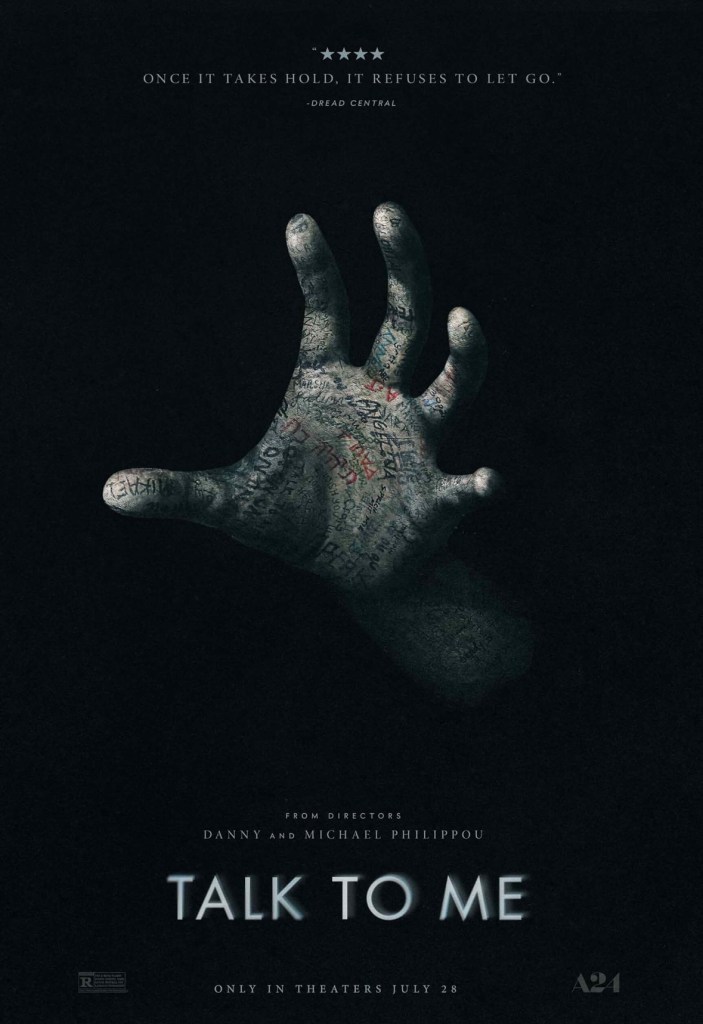
Upon discovering a relic that has the power to ritualistically conjure spirits, a group of friends becomes obsessive leading them to face fears of the unknown afterlife as it begins to infiltrate their lives…
Horror is often only as strong as its central allegory, but there are exceptions to that rule. There’s nothing particularly remarkable about the allegorical conceits of Talk to Me. Certainly, many others have dared to venture into horror under the guise of exploring grief, particularly the sense of turning back time, the obsession to be with a loved one again, to feel the comfort of them as they alleviate you of your fears.
Many films have dared to endure horror as a genre reflection of the often misguided endeavors of teens, their exuberance to feel something new and exciting often acting as a form of Icarus braving toxic patterns to feel a sense of euphoria that can only bring about an inevitable doom. There are moments in Talk to Me, particularly the third act of the film, that broach territory that audiences may find to be frustratingly typical.
The narrative can tend to hide behind contrived ‘insanity’ that causes some unreliable circumstances that require a touch more world-building to substantiate. But Talk to Meis is not exceptional in the things it talks about but rather the way it talks about them. It’s a movie bolstered by sublime performances that capture desire in such a relatable way that it’s often forgivable to see them make poor decisions and careen toward such unfortunate predicaments. It’s a film that heightens every moment with sublime cinematography, often capturing a sharp tilt of the camera or a hazy shallow focus to strike with precision on the exact nerve point that will best merge the audience’s suspense with the character’s.
Even the score can effortlessly reflect the fluctuating tone as our delightfully chaotic ensemble cast ranges through their ritualistic practices with carefree joviality, only to watch in horror as the house of cards being toyed with in the narrative slowly comes crumbling down. The most impressive aspect of the precise filmmaking at the center of Talk to Me is the ability to craft a story that is wildly flexible, and open to interpretive moments as our central character verges further into insanity, yet it leaves context clues to bring an audience to chilling narrative conclusions.
Take for example the delicate use of water in the sound design, how it influences the audience’s understanding of an antagonist; and how it ramps up to a fever pitch allowing the audience to draw conclusions about certain masks that the enemy may be wearing. Talk to Me is one of the most calculated directorial showcases of the year, toeing the line between heart-palpitating shock and endearing drama all wrapped in a bow of stunning horrific imagery shrouded in a veil of ritualistic demise.
Unlike lesser films that broach similar topics, Talk to Me can surpass expectations set by its contemporaries. Although there is no doubt from an objective lens that these characters are careening toward disaster, there lies a harrowing truth that we—the viewers—would likely have been too curious, too heartbroken, too excited to have done much different. 9/10
- Anatomy of a Fall
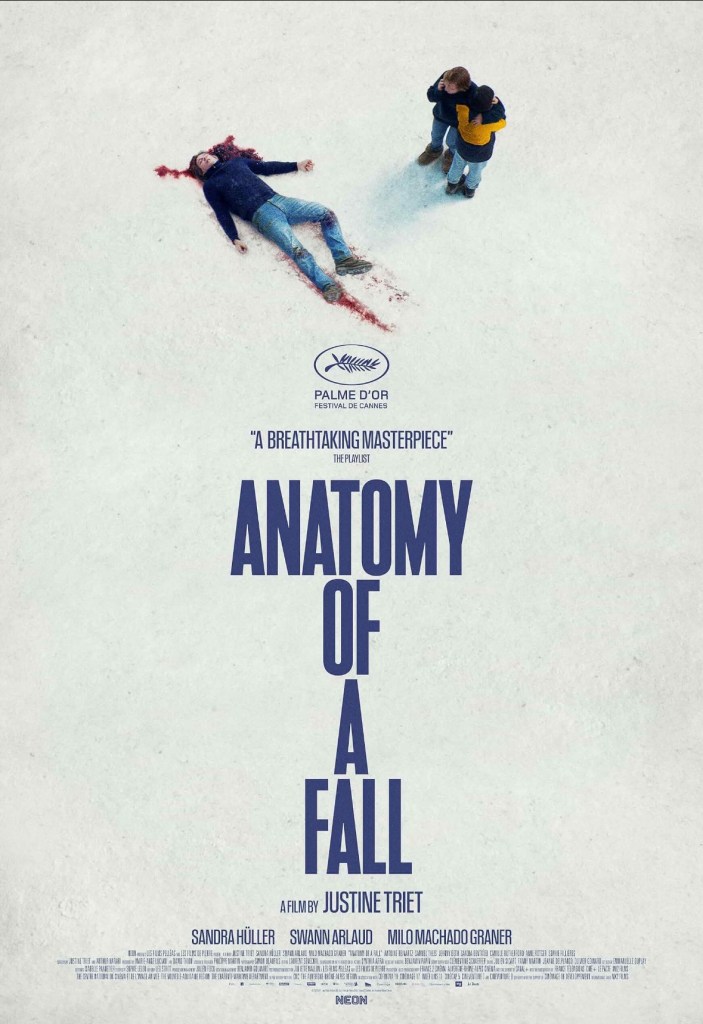
A German writer is suspected of murdering her husband allowing a lengthy trial to dissect their private life in front of their son, a key witness in the case…
Guilt is an interesting thing. In my younger days, I would resign to believe that guilt, as determined by the court of law, was a tried and true formula, a pin-point accurate breakdown of societal functions with no political agenda, but in the wake of tragedy after tragedy, overturned racial cases dating back forty years, domestic abuse allegations prominently displayed on TikTok live streams for everyone to dissect into oblivion, it would seem that the judicial system in the world at large is more akin to grasping at straws, placating to people in the hopes of occasionally finding objective truth.
Anatomy of Fall toys with the notion of our fundamental understanding of guilt from the very outset of the film. The interview with our protagonist, a popular author Sandra Hoyter (played by Sandra Huller), immediately flags in the audience’s mind as suspicious. There are moments of sensory ticks, and oddities that layer over this initial conversation, whether they be the bombastic music that rudely interrupts the interaction with little to no explanation, or the mid-day wine offering as a guise to steer clear of sensitive topics.
From the outset, Anatomy of a Fall establishes a delicate foundation that demands intense scrupulous focus to determine the audience’s alignment. Once the death at the heart of the story unveils itself, the audience is forced to grapple with their own suspicions. In such a short frame of time, Anatomy of a Fall introduces a litany of evidence—often subtly and masterfully laying exposition over tightly wound character development—that begs the question of guilt. Even moments that are designed to give clarity are rooted in a deeper sense of messy truthfulness.
Take for example the juxtaposing positions of scientists—blood spatter analysts and coroners—who each come to a seemingly valid conclusion. It becomes clear early in the film that however the case is determined, the objective truth of the matter may never be unveiled. The script masterfully weaves this fragile web of marital vulnerability splayed bare in front of the court for everyone to dissect, culminating in a climatic revelation played out in an audio recording that should be evidence enough for Sandra Huller’s Academy Award nomination.
Yet, it is the third act that reveals the true beauty of the screenplay. As Sandra’s son grapples with his own moral fortitude in a conversation with his court-appointed watcher, the conclusion drawn appears to be that none of us truly know an objective truth, but instead, we choose, and the evidence follows. While the final moments of Anatomy of a Fall may feel anticlimactic to some, they are harrowingly real in the understanding that life is irreparably damaged by the simple question being posed of Sandra’s innocence or guilt.
Were it up to this writer, the screenplay crafted by Justine Triet and Arthur Harari as well as the performances from Sandra Huller and Milo Machado Graner would take the award’s season by storm. Not to mention Messi, the single greatest dog performance of the year—and perhaps of the past twenty as well.
All of this is to say nothing of the masterful delicacy with which Justine Triet subtly frames these moments in her directing style. The simple and provocative use of flashback to better detail moments only to cut back to the present to give an overarching sense of doubt, the sublime lingering camera that saddles us in the emotional depths of Sandra as she sheds tears, but are these tears out of guilt finally catching up with her or innocence yearning to be vindicated?
Anatomy of a Fall is a film about not just the anatomical details of a literal fall, but the metaphorical exhuming of character. It is the offering of oneself to judicial practices only to find that the objective truth is absent and in its place lies an irreparable demolition of character that will linger far longer than any verdict ever could. 9.5/10
- Poor Things
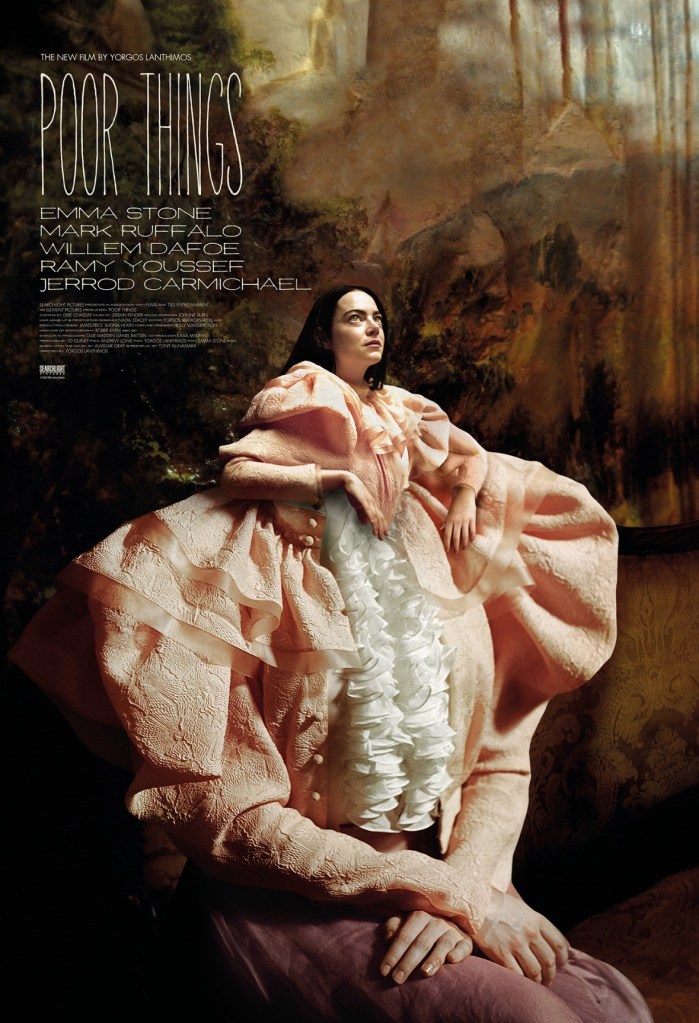
In a fantastical world, Bella Baxter, who is brought to life through Frankenstein-ian means, embarks on a journey toward self-discovery through sex, philosophy, and liberation…
How interesting is it that Poor Things and Barbie came out in the same year? Surely others have remarked about the former being a sort of bizarre-o sexy, dreamlike companion piece to the latter, but the similarities are even more prominent than one might typically presume.
Both feature a naive female lead, flustered and awe-inspired by the world at large, forced to venture forth into the chaotic wasteland of reality outside the confines of their idealistic circumstances. In tow, they bring a male companion who is bewildered by them, often obsessed, and through this lens of obsession this companion becomes a hysterical, anguishing antagonist that aims to subvert the heroine back into a role of confinement.
Both of our leads heed the call to follow their own moralistic intuition, rebuke the confines of societal norms, and bolster their own existence with an acceptance of found family. Oh, but Poor Things has a lot of sex in it, so I suppose they are a bit different.
Poor Thing is a visual feast that showcases this journey toward female enlightenment through a deeper contextual understanding of sexuality and exploitation. Bella’s growth from an adolescent-minded babe into a full-grown adult doesn’t simply come in the form of philosophical intrigue and fascination at the world, but rather how she physically interacts with such a world to appropriately establish the boundaries of high society.
This journey in turn feels wholly original in every aspect, whether it be the steam-punk, gothic-inspired production and art design, the musical score that trills Bella’s wonderment only to grow heavier and more somber at her discovery of the more sinister machinations of the world at large, or the performances—namely Emma Stone who manages to cement Bella as the hallmark of her career. Stone’s performance often acts as the catalyst through how the audience must question the world, the open door through which director Yorgos Lanthimos is allowed to introduce us to a societal landscape of lavish scenery in timeless wonder.
But Stone’s ability to play, her commitment to the physical attributes as well as the earnest curiosity that makes Bella so charming, is the foremost reason for her rise to Academy Award frontrunner. Lanthimos films often feature wily coyote-esque characters, daring to brave towards their desires with cartoonish earnestness, but here because Bella’s fundamental principles are so centralized, so specific, and so morally comprehensible, Poor Things manages to make for one of Lanthimos’s best and funniest works as the characters around her flounder to compete.
The justification of ‘it’s just the way the world works,’ that a half-assing father may give to a curious child cannot work on Bella, a full-formed woman in every respect but her mind, and thus characters often face anguish at her stubborn adherence to her own personal desires, or marvel at her delightful whimsy. Poor Things is a strange film. It’s a film that often oscillates between showcases of visual flourishes—often opting to demonstrate its peculiar brand of world-building with something like Willem Dafoe burping in place of a conversation—and intense philosophical revelations about what it means to be alive.
Sexuality acts as the catalyst for Bella’s self-discovery, but much in the same way that many adolescents assume sex is the pinnacle of human existence only to lose their virginity and ask themselves, ‘And now what,’ Bella’s self-discovery takes shape in a richer, more nuanced light. But prudishness may keep many audiences from seeing the joys of Poor Things.
Perhaps more importantly, Poor Things relies heavily on its stylishness to such an extreme as to seem gratuitous at times. Its final third adds a sort of epilogue that tests Bella in what she has learned on her journey thus far, and though it allows for the always marvelous Christopher Abbott to showcase his talents, it feels as though this portion of the film adds no new information to Bella’s journey apart from her affirming what the audience has already understood of her.
These criticisms, while valid, do not negate Poor Things as being one of the most enjoyable experiences in cinema this year. For audiences with an open mind, Bella’s journey in meeting these disparate characters, these poor things, is a visual delight that offers a humanistic, moral, and philosophical narrative complimented by stunning work below the line and in front of the camera. 9.2/10
- Oppenheimer
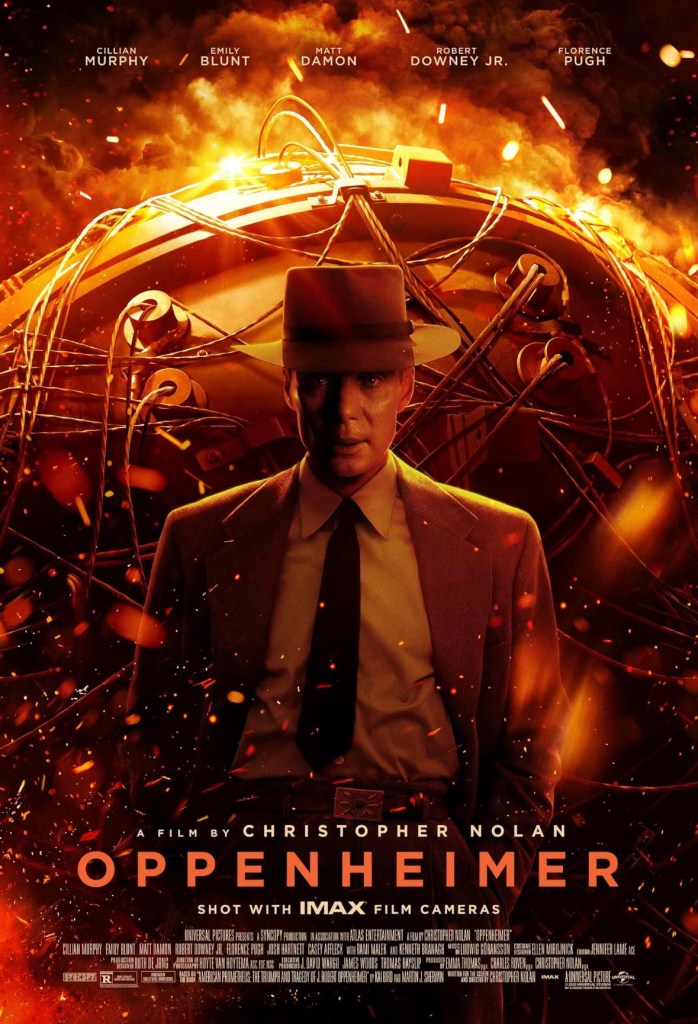
Tells the story of J. Robert Oppenheimer, the famed American scientist, most notable for his work on the development of the atomic bomb…
It is perhaps fair to assess that Christopher Nolan has made his magnum opus with Oppenheimer, a film dedicated to unraveling the tragic genius of the most fatally curious scientist of our modern age, weaving through his various exploits in non-linear framing that proves the culmination of Nolan’s previous endeavors.
Nolan’s penchant for editing nonlinear stories into a stack of weighted scenes that uniquely influence one another can be trying, particularly in his works that seem more obsessive over concept than character, but here everything tracks marvelously.
This is a credit to Nolan’s sublime script work, translating Oppenheimer’s mind into a first-person narrative (a true joy to read for any cinephile curious enough) only to then transition to a more objective and traditional third-person narrative.
The weight of Oppenheimer’s exploits can be mystifying. From a mere examination of the facts, Oppenheimer never did sign the petition against the use of the atomic bomb on Hiroshima and Nagasaki, and from this simple fact alone, it could be easy to conclude that Oppenheimer was evil. Nolan works with this concept delicately, and as he weaves the complex tapestry of discovering who Oppenheimer was, it becomes abundantly clear that this gifted mind was plagued with insurmountable guilt.
Does it excuse the creation of such ruinous means?
That is left for the audience to decide. This is the tip of the proverbial iceberg in identifying Oppenheimer’s themes. Through Lewis Strauss and President Truman, we see a much more sinister uncovering of the world, a depiction of the American ego as being the true destructive entity of politics.
Through Leslie Groves, we see a dutiful dismissal of individual moral ideology for a perceived greater good. Through Kitty, we see an unending loyalty and frustration that the greatest mind of the modern age succumbs to his own guilt and allows his private life to be picked apart in the hopes that his suffering will absolve him.
This is some of the most detailed character work that Nolan’s pen has ever endeavored, and as a result, Oppenheimer becomes one of the most well-structured and detailed scripts of the year. But a script is merely a blueprint. Oppenheimer succeeds in execution as well as planning. Nolan’s signature exemplary visual effects and sound design are on full display here, but with Oppenheimer, there is a notable restraint that makes them succeed epically.
Rather than crafting a spectacle piece that overstuffs the film with a robust display of imagery and technicals, Nolan dials back and allows the characters and story to clear the way for epic sequences. The Trinity Test becomes one of the crowning jewels of Nolan’s achievements in cinema, showcasing some of his most daring and exciting effects work as the story propels us to this iconic visual, rife with tension and suspense as anyone would expect from this master storyteller.
But it is a moment that immediately follows, the gymnasium sequence, which layers together the most acute and harrowing depiction of sound design that I have ever seen. Oppenheimer’s subjective perspective allows us to see a fold in the world, opening a door into the recesses of his mind as the gravity of his creation throttles itself into focus.
True, Oppenheimer does not ‘necessarily’ show the details of the consequences of the atomic bomb, but much like another great film from this year, Zone of Interest, we walk away from this calculated avoidance with a visceral understanding of the cost that doesn’t endorse the actions but rather admonishes them.
Oppenheimer’s greatest struggle is its runtime. It’s an airtight edit that makes every sequence necessary, but one does hesitate to think if the third act, in its entirety, wouldn’t be better served in a separate story. The revelations surrounding Strauss, while magnificently performed by Robert Downey Jr., showcase as a surprise to an audience that should see them coming from the very outset of the film.
This adherence to a contrived plot twist over-embellishes the necessity of creating a sort of antagonist for Oppenheimer, and one wonders if the story wouldn’t be better served to sideline Strauss to a more peripheral character as we saddle deeper into Oppenheimer’s psyche. It’s a nitpicking point when considering some of Cillian Murphy’s very best work lies in this quasi-epilogue, seeing his unraveling anguish over his trial, his awe over the fortitude of his wife and friends, and even his final conversation with Albert Einstein.
Oppenheimer is uniformly excellent in every sense of the word. If film’s aspiration is to combine all of the artistic forms available from music to art to writing to performance and fuse them into a cohesive whole better than the sum of its parts, then Oppenheimer is perhaps the best film of the entire year. 9.5/10
- Past Lives
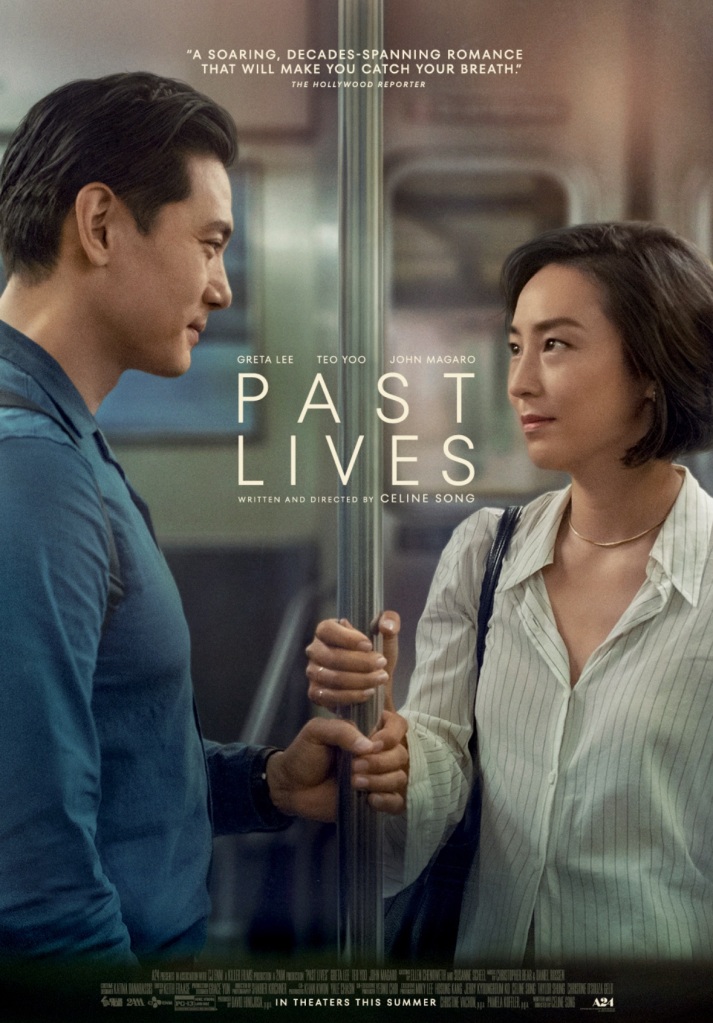
Shows the interconnecting lives of two childhood friends, Nora and Hae Sung, as they unintentionally test the boundaries of their tethered souls amidst a world that forces them to confront their understandings of love…
2023 was, to me, a year of unquantifiable hardship. It was a year that seemingly marked a collective understanding of our shared anguish. In the wake of the pandemic, it felt as though this was the first year where many of us, at least in circles that this writer finds himself in, could take stock, and what we found in the counting of our lives proved to be troubling pains that lurked in the shadows of our deepest anxieties.
I—personally—felt as though this was a year of profound sadness, a feeling that could not be measured by any one specific hardship but instead felt like the culmination of years of repressed grief. Whether it be a childhood lost to time, a friend or relative scattered to the wind, or a dream laid bare only to be washed away, this was the year that it seemed to all come to the surface.
This seems an odd and lengthy introduction for a write-up on Past Lives, but a movie as deeply felt and profound as Celine Song’s poignant film requires meditation. Past Lives is a movie meant to settle viewers into a feeling of this aforementioned collective grief, aiming to appeal not to the literal measurement of intimacy but rather to the captivating and illusive feeling of longing.
The title works not merely as a commentary on decisions made that leave important elements—often important people—behind in the lives we leave in our wake, but also as a yearning for the tethers of time to show us another thread, to allow us the opportunity to see that other path as it passes us by. There is an unquantifiable grief that lingers over our three leads.
For Nora, there lies an overwhelming sadness as the trajectory of her life forces her to rebuke a connection manifesting into an inherent guilt over her own perceived selfishness. For Hae Sung, it is a grief of longing, the knowing that the love of your life lies just out of reach, the desperation to force two beautiful pieces of a puzzle together only to realize that the colors don’t match despite their pegs.
And for Arthur, a character we meet only halfway through the picture, it is a desire to support his wife, the sure-fire love of his life, knowing that her dreams may take her to a place he cannot follow—watching helplessly as the one he loves makes an active choice to stay with him despite an emotional pull that drags her towards an unquantifiable kinship with another.
Song’s screenplay beautifully captures this deep-felt, bittersweet tragedy, rarely ever remarking on the anger of the situation, the frustration which would be so relatable and yet so tired and formulaic. Instead, Song subverts the expectations of her audience and insists instead that love can prove more powerful.
Nora’s husband has every right to storm and fuss and rant and rave and bemoans his ostracized position in this uncomfortable love triangle, but instead, Arthur appears as an earnest observer. He attempts to learn Korean to provide a more stable middle-ground for his wife and former best friend, but—more to the point—he longs to understand the facets of her mind grounded in Korean, to wander into the machinations of her thoughts and to understand them as more than a mere translation.
There is an intimacy in these characters’ wants that seldom gets broached in even the most nuanced of dramas. There is often more heart in a single line uttered by one of these three than most films could have in an entire runtime. It’s often elusive to me how we love in the way that we do. I hem and haw about love being a choice, a promise you make over and over, versus an intrinsic value, a thing as natural as breathing that happens organically with no rhyme or reason.
Surely, I’ve felt both. I’ve endured Nora’s silent walk of thoughtfulness trying to piece together the paths that lead to such a feeling of taxation on my soul. The line I continuously come back to in Past Lives is one that Hae Sung says to Nora. He tells her, “I love you because you are you. And you are someone who leaves.” Song doesn’t have her characters waste time trying to rant and rave around their articulate points.
She strikes with precision, each line of her script proving the conceit of her thesis: that love, whether it is a choice or not, exists, and in this existence, we must grow to accept that it envelops us in ways beyond our comprehension.
The best we can do is be waiting on the steps ready to embrace our loved ones when they cross paths with love’s enigmatic desires. 9.5/10
- The Holdovers
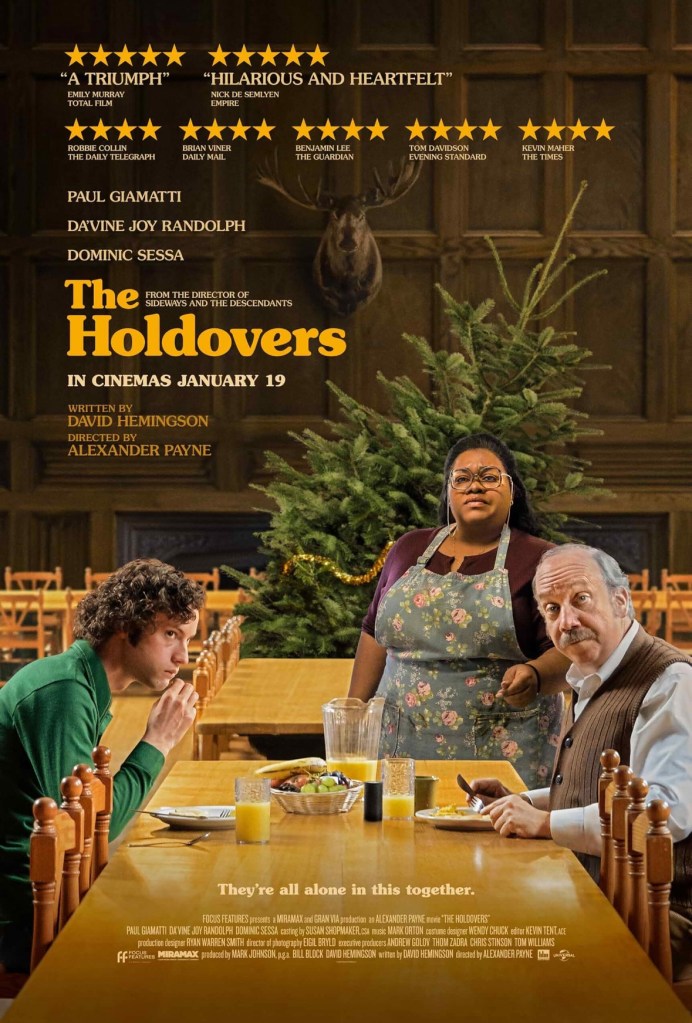
A curmudgeon teacher is forced to stay through the holidays at a boarding school watching after the holdover children who were left behind…
In today’s age of Hollywood nostalgia, it would be easy for The Holdovers to have cashed in on some 70’s/80’s iconography, passably allude to an essence of commercialized realism, make a few references to things people may feel fond of (‘Oh, yes, remember 8-track players?’ Or ‘I loved the music in Fast Times at Ridgemont High!’) and call it a day.
Instead, The Holdovers insists on the hard route, detailing a meticulously grounded framework of fully realized characters, each deeply felt and longing for a place in this mournful world that insists on rewarding ‘little assholes’ over people who have tried to earn a place in the roster of importance.
The Holdovers cements itself is far more than simply a charming story of a time gone by. Director Alexander Payne crafts a nostalgia frame for The Holdovers fully complete with film grain, long lenses, and careful staging harkening back to a John Hughes style that sets the stage for the characters to truly shine. It’s notably hilarious, often juxtaposing character ideologies, pitting them against each other in intimate environments that force begrudging opponents to see commonalities in their ways.
The Holdovers utilizes an iconic trope to its advantage, taking a curmudgeon mentor and a naive student and forcing them to see their faults. Watching Hunham and Tully slowly, painstakingly unite over their shared sense of suffering—of feeling less-than—makes The Holdovers one of the most joyful watching experiences of the year. The performers are uniformly excellent with newcomer Dominic Sessa crafting an earnest joviality that meets fiercely with Giamatti’s playfully sardonic turn. But it is Da’Vine Joy Randolph who steals the show.
Mary Lamb is a character designed to intuitively understand the feelings of being ‘left behind’ as she listens to the bemoaning of these two frustratingly stubborn players butt heads over silly trivialities. Randolph takes an understanding, observant character and imbues her with an unmatched emotional undercurrent.
Oftentimes, her delivery of a single word like, “College,” will have more emotional impact than most actors could dream of having in a two-page monologue. The first act of The Holdovers sets the stage for its growth, but endearing yourself to these characters and seeing the inner workings of the larger story that is attempting to take shape here is the film’s biggest obstacle.
Upon rewatch, seeing the subtle and calculated ways in which Payne demonstrates character arcs becomes one of its most enjoyable qualities, but for first-time viewers, The Holdovers is a film that will appreciate in value as it goes on.
The script by David Hemingson is masterfully crafted. It’s a film willing to take its time in building jokes with meticulous reference referral, often hitting a punchline in several scenes removed to reward audiences that are invested in the characters’ journeys. As it works towards slowly breaking down all of the points that make Hunham unlikeable and turning them into endearing qualities that speak to his upstanding morality, it passes that quality to its audience.
The Holdovers is a triumph in character development, in comedic release, and most importantly, it is a triumph in capturing a snapshot into the insecurities of those of us who feel undermined by a society dismissing our potential.
It is a film about championing people who feel forgotten, held over, waiting for an opportunity to step forward into the world with curiosity in place of judgment, eager for a loving embrace to find us when we’re done. 9.5/10
- All of Us Strangers

An aspiring screenwriter discovers upon revisiting his childhood home that he has the unique opportunity to interact with his dead parents just as they were 30 years ago…
There is an indelible quality to All of Us Strangers, one that I cannot quite seem to shake. I’ve lingered over its ideas for the past few months since I saw it, and I’ve been hard-pressed to articulate why it moves me in the way that it does.
It’s not a particularly relatable story, lest one is face to face with the ghosts of your past, musing over unobtainable writing goals whilst discovering you and your new lover may be the only two souls in an entire apartment complex. No—no. I take it back. The premise of All of Us Strangers is devastatingly relatable.
The ghosts that we knew, whether they be people or the yearning for a moment—a connection—never to come to pass, is a universal desire. The feeling of being lost, floundering through a monotonous existence with no real anchor, no clue how we got there, only to find a haven in someone whom we want to share our whole world with.
Forgetting the pressure of logic or sense, All of Us Strangers explores the deep-felt emotional binds that tether us to one another. The particular brand of melodrama here may be difficult for some.
All of Us Strangers imagines a world in which everything left unsaid can now be brought to light, and as a result, audiences may feel alienated by a script that breaks all forms of convention to extrapolate its results. In its third act, it becomes particularly trying as it tends to break even the conventions of its already flexible world-building to allow for even more leniency in audience interpretation.
Yet, there is a noticeable truth within this premise, this challenge, that enriches the audience experience if one chooses to engage with it. The hypothesis at the center of the film seems to postulate that perhaps if we are brave enough to truly admit it, we all live with ghosts.
The ghost of nostalgia that allows us to yearn for the embrace of our mothers in the middle of the night as we scamper to our parents’ bed. The ghost of longing for our fathers to embrace us for our secrets, to love us despite the times, despite the fears of what our futures may hold.
The ghost of an embrace with a loved one as we embark on a journey through an ethereal escape from reality into a world where we can just be forever, carefree and high, shrouded in a sea of strobes and starlight.
All of Us Strangers is a ghost story and explores a world in which the past can meet the present in a perfect harmony that blends truth and fiction. Perhaps none of it makes sense, and perhaps none of it has to so long as it feels real.
Anchored by four of the finest, most heartfelt performances of the year, All of Us Strangers manages to navigate the planes of existence in a melodrama that takes a Pollickian paint brush to all emotions and smatters them across a broad canvas.
At its very core, acting is a translation. It is a practice in presenting ideas, thoughts, and feelings, to a story and communicating them to an audience. In that practice, each of the four leads here stands head and shoulders among the finest communicators of the year, enriching our experience with a breadth of emotion rarely observed with such astonishment of heart.
Andrew Haigh crafts a menagerie of sorrow, the full ambitious showcase of grief, and lays it bare. The truest tragedy of All of Us Strangers is that I cannot ever experience it again anew, cannot ever embark on the journey without knowing the destination because seeing stars in the night sky for now and forever more will be an experience that is intrinsically tied to this film. 9/10





Leave a comment