

This is now my seventh annual Top Ten Films list to be published by Movie Burner. Before the list actually begins, I just want to take a moment to say that I am forever grateful to them for giving me an outlet, allowing my musings and longwinded pretentious thoughts to have a place to call home. My mind is often a prison of over-thinking, complicated and torturous cycles of justifying and re-justifying my own opinions. To have a space for some relief, and to have the opportunity that someone may read it and find some value in it, even just one person, that is monumental, and that is what film—as a shared experience—is all about. So thank you, Movie Burner, yet again. And thank you for clicking on this write-up. Whether it’s your first time or your seventh, thank you.
What to Expect
Below is a list of my Top Ten Films of 2024. (I’m going to copy and paste this next little part here from last year’s list because I realize that I articulated it far better than I anticipated. It’s always a surprise to me when I read something I wrote and go, ‘Oh wow! That is exactly what I meant to say’.) I have a philosophy that there is a certain sense of objectivity in criticism that all critics should aim for. Because of this philosophy, I tend to consider that something I recognize as ‘the best’ does not always necessarily constitute ‘my favorite’. You will see an eclectic list counting down from 10-1. For each film, I have taken the time to try to best articulate what I enjoyed about it, as well as a brief mention of criticism trying to capture a sense of that aforementioned objectivity.
I score each film on an 100-point scale. You’ll surely notice that some films will have higher scores on that 100-point scale despite being lower on the list. This is by design in the hopes that we can capture some of that objectivity. But if you disagree with the philosophy, it’s perfectly fine to simply ignore the scores. If a film made this list, I wholeheartedly endorse it, so a score matters hardly at all. No matter what, I just hope you enjoy the journey.
The write-ups are something I work very hard on, and though they don’t intentionally contain spoilers, I would certainly say that the context within them is likely better appreciated if you have seen the films through to completion before reading. Whether or not you read these blurbs before watching these films I leave to your own personal discretion.
There will be run-on sentences, poor use of commas, and all sorts of linguistic rules broken. There will be first-person writing, second-person writing, and all the bad writing you could imagine. But I hope that these write-ups can at least capture the heart of what made these movies so special to me. Maybe they will articulate what makes them special to you too.
The List
I like to begin each year with honorable mentions. I would say I see far more new releases in a year than the average viewer, and occasionally more than the average critic, but if you notice films missing from this list, it is possible that I have not seen them yet. Some important mentions still on my watchlist include A Real Pain, Hard Truths, All We Imagine as Light among several others. If there’s a movie you were anticipating being on here, feel free to ask me about it. I am shockingly accessible online, so by all means feel free to direct message any thoughts or opinions you may have.
I will be extremely candid in admitting that this year was one of the hardest compilations of lists I have had to curate. I found myself splitting hairs quite frequently in how one film stacked over another. There are several of these honorable mentions that at one time were in the Top Ten, but were moved out for benign reasons. At the end of the day, none of my published lists are exactly right. I saw my favorite movie of 2018 well after that list was published. I have since rewatched Little Women every single year since it came out in 2019 and would have retroactively placed it at my number one spot for that list if I could. This ranking thing…it’s never an exact science. It’s just something I like to do. So thank you for entertaining it despite its flaws.
In no particular order, my honorable mentions are…
Conclave – a picturesque film with an engrossing mystery that overlays the action
Nosferatu – the most visually stylish gothic horror to come in recent memory
Ben and Suzanne: A Reunion in Four Parts – one of the most endearing romantic comedies in recent years (and made by my very own Film History teacher from college)
Furiosa: A Mad Max Saga – an action spectacle with a career defining performance from Chris Hemsworth
La Chimera – a melancholic and emotionally rich character drama
Now, let’s begin…
10. Will and Harper
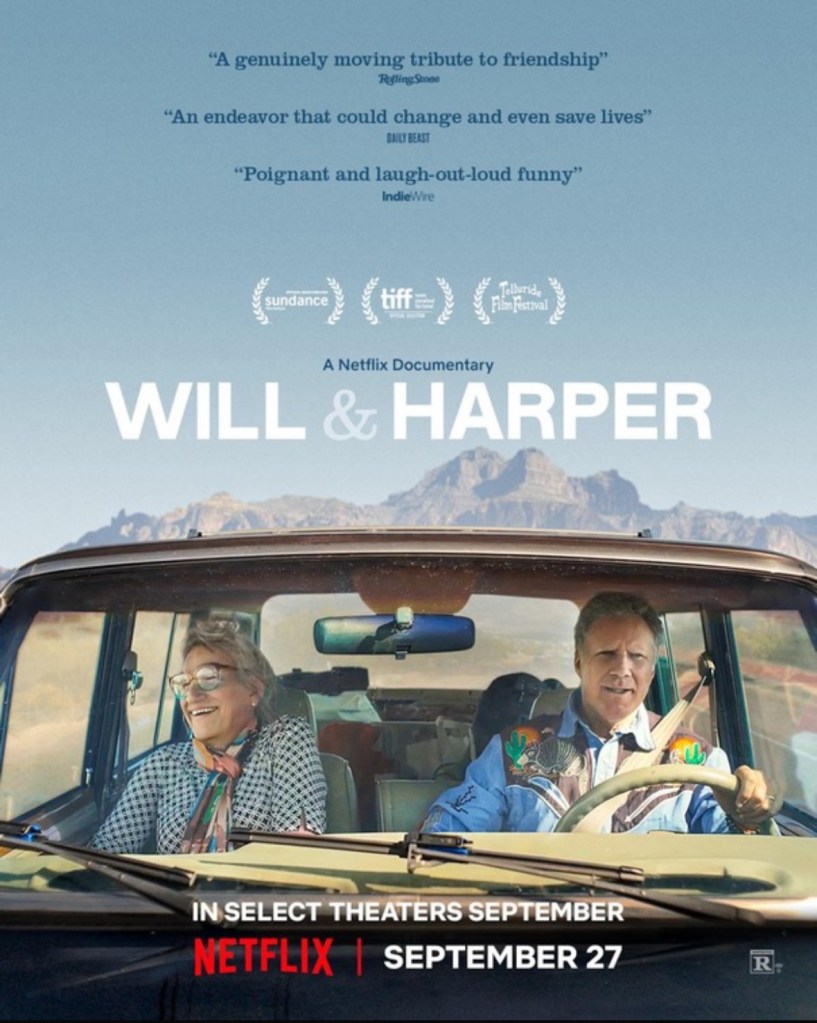
In this documentary, two friends take a roadtrip across the continental United States in an effort to reconnect with each other and the world at large after one of them transitions from man to woman…
If you’ve known me in all my pretentious glory in recent years, it is likely you’ve heard my ‘anti documentary diatribe.’ I’d like to take this opportunity to clarify the speech a bit, if I may, and assert that I am not a documentary hater. I bemoan the streamlined, content-fetishization of most documentaries that seemingly get popular nowadays. Netflix made a concerted effort in the past decade to put millions of dollars into popcorn documentary content with stylish cameras and shallow focus hyper-inflating contrived intrigue within deeply personal traumas. Also, the headspace on the confessionals often serves no visual purpose and it drives me insane. This, so far, is an incredibly poor review of Will and Harper. Let me return to the point. What I mean to say is I think it is ironic that a film like Will and Harper comes along on Netflix(!) and manages to strike with such an authentic hopefulness and empathetic lens. There’s a brilliant self-awareness that graces Will and Harper and invites a more personal exploration for the audience. It’s a cliché to acknowledge the vitriol that spews in the modern age through the luxury of social media, but that truth is a vital component of Will and Harper and by association our understanding of the landscape that they must navigate on their journey across America. The thesis of the film is two-fold: there is a literal road trip across the US, a desire to uncover a macro-truth about how pervasive the widespread political ‘controversy’ of the trans-community truly is, and an interpersonal journey in which Harper and Will can ideally reconnect with one another and be able to better talk about their experience as individuals. What ensues is a construct of pure empathy, not just for Harper and Will who unveil so much of their shared experience in such relatable ways that it should be normalized, but also for the nation itself. I often find myself bitter about the world looking at overarching outcomes of political elections and tying narratives that speak to generalizations and collectives about where the country’s heart has fallen, but the beauty of Will and Harper is that it reminded me—if only for an hour and 50 minutes or so—that the truth is likely far less easily categorized by boxes of hate and not hate. On the film’s journey, Harper experiences the full gambit of spiteful hate bred from insecurity and lack of learned empathy, but she also experiences joy, compassion, inclusion, and recognition. The racetrack sequence remains the crown jewel of the film not only for its cathartic release, but simply because it paints so clearly the picture that the human experience is a shared one. Harper feared being ostracized, feared the hate she would receive from the world because the world insisted on telling her that’s what it was wiling to give her, and even if it was only for the briefest of moments at that racetrack, in that bar, or in any of the countless places across the country, the world was willing to say, ‘no, come out to the track.’ For Will’s part, there is an important lesson in being a friend. It would be easy for Ferrell to rest on his laurels, place the cameras in the car in an effort to puff-piece himself comfortably further into superstardom, and it is this level of self-awareness that makes Will so honest in this film. It’s not lost on him that he has a position of authority—for lack of a better term—in dictating how this particular dynamic can unfold. Will Ferrell wisely helps in setting the stage for the film from the perspective of a layman, as if to say, ‘many people have these questions that they are too scared to ask, so let a star like Will Ferrell be the analogue for those curiosities.’ In working through the discomfort, Will’s eyes open empathetically in the same way that one hopes the less-exposed audience’s would as well. The question of the ‘success’ or proof of thesis about the world of Will and Harper is perhaps its only drawback. Is its artistry a mirage only capturing moments that paint another narrative for a more encouraging and accepting future? A documentary chronicling a moment in time can only be as successful as its subjects are willing to allow, and are we perhaps seeing the best behaved of the passersby as they yearn to have a drink with Will Ferrell? I’d like remain optimistic that it’s not an illusionary experience for America, but it remains to be seen. It may be naïve of me, but I would like to believe that in seeing a shared experience, in relating to something onscreen, Will and Harper does have the power to save lives. And if not, then perhaps relating to the journey of an interpersonal friendship, sharing in the catharsis of Harper as she reveals herself in that poignant moment outside of her mid-century modern house that she purchased to isolate herself from the world that she thought hated her, maybe that in and of itself is enough. 9/10
9. Wicked
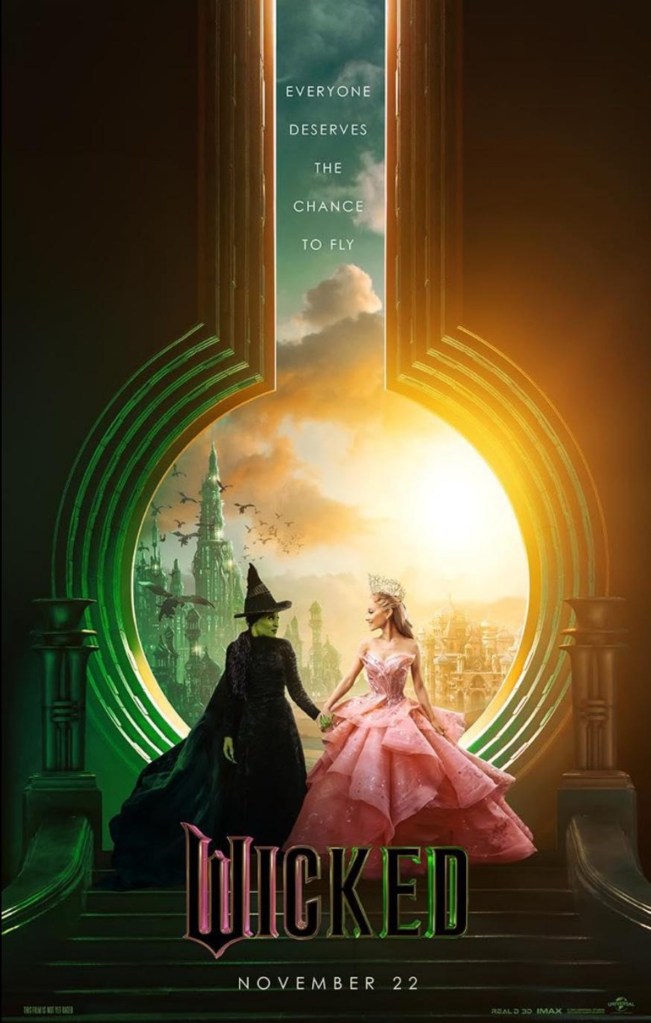
A prequel to The Wizard of Oz, Elphaba navigates through magic school making friends and enemies alike as she begins to uncover foul machinations at play in Oz…
I have not had a preconceived bias towards a film for a long time, but I must confess, and it is much to my shame, that I did not expect to like Wicked. I admit this so that you take it from me how exceptional Wicked is. There are other important notes to make here: I have never seen Wicked on stage. As of writing this, I have no cue what happens in Act 2. Prior to this film, I had heard one song. I come to you today as a Wicked convert, groveling before the masses of Wicked fans begging for forgiveness in my ignorance, and pleading with those of you who may be like I was. Perhaps you’re thinking the film is made for kids, made for musical enthusiasts, or perhaps—most cynically—a cheap cash grab. And while I certainly take issue with the splitting of the film into two parts as an unabashed attempt at studio heads siphoning money out of the general populace and forcing the wonderfully articulate director to artistically justify the choice, Wicked is far more than the production pitch meeting that the skeptics have in their heads. There’s a clear vision director Jon M. Chu has for this world, keeping much of the practical design to harken back to the iconic visual aesthetic from The Wizard of Oz, but also adapting the frenetic energy of the stage to make Wickedfeel wholly unique for the new viewer. You can hardly scour Twitter for a minute without coming across opinions (generally made in bad faith, in my opinion) regarding Chu’s direction, and though there is certainly criticism to be addressed, there is much to be lauded. The camerawork is pristine, precise, and calculated adding such a strong visual implication to the choreography so as to make one assume the musical was built for the movies as opposed to the stage. Oftentimes, the camera feels like the lead dancer, guiding the meticulous movements and pronouncing nuances in performance and musicality that otherwise would be left to only eagle-eyed viewers. Wickedis smart in its simplicity this way, never reaching far to add that small token of visual intrigue, but always layering it in to showcase Chu’s reverence for the material. Plenty has been said about Wicked’s immaculate songs and score (this adaptation taking special care to add influences and homages aplenty), but even more praise can be added to the iconic vocal performances in the film. Erivo is a powerhouse vocalist, but her performance is at its very best in the quiet moments between the action that Chu and screenwriters Winnie Holzman and Dana Fox take care to layout in giving space to the action. But the star of the show is Ariana Grande who beautifully takes space (if you caught that, you’re too online) to make Galinda a multifaceted character built for more than comic relief. Grande’s choices are so sincere and lived in that a simple embellishment of emphasized theatricality becomes an authentic eccentricity of the character. The rest of the ensemble cast certainly shines—perhaps too brightly with the film’s seeming insistence on over-exposure in the lighting—but it is Grande at the film’s center that grounds the film with emphatic gravitas. Of course, the film is far from perfect. At its core, the pacing of a two-act structure cannot support two feature length films. Wicked’s biggest flaw is that it ends just as the story actually begins, a triumphant crescendo to a cinematic climax that definitely leaves the audience on a high as they watch what is essentially a superhero transformation is abruptly cut short. It sounds gluttonous to say, but I would have preferred an intermission and Wicked Part 2 to be available in one swoop, and damn the world if they complain about a 4 hour runtime (as Roger Ebert once said, a good film can never be long enough). (Slight spoilers in the next sentence) There are simply too many moving pieces that all have to fit neatly into place between A Sentimental Man and Defying Gravity, and it feels unjust to the story’s pacing to rush through Elphaba going from golden girl to an international terrorist in the span of a half an hour. The audience is forced to buy-in on quite a lot, but perhaps nothing is more confounding than buying into the fact that a world with talking animals would be so off-put by a girl simply being green. Yet, accepting Wicked at face value is part of what makes this fantasy so innately compelling. As a genre, fantasy is meant to define our world through extreme circumstances in order for us to reflect on its emotional truth, and the truth at the center of Wickedstrikes to such a universal core. We have more to us than a binary code of wicked and good. And also, sometimes, revolutions are defined not by the anarchists but by the story framed against them. (Please don’t spoil Act 2 for me as I would like to let Jon M. Chu and company do that themselves). 8.5/10
8. Babygirl
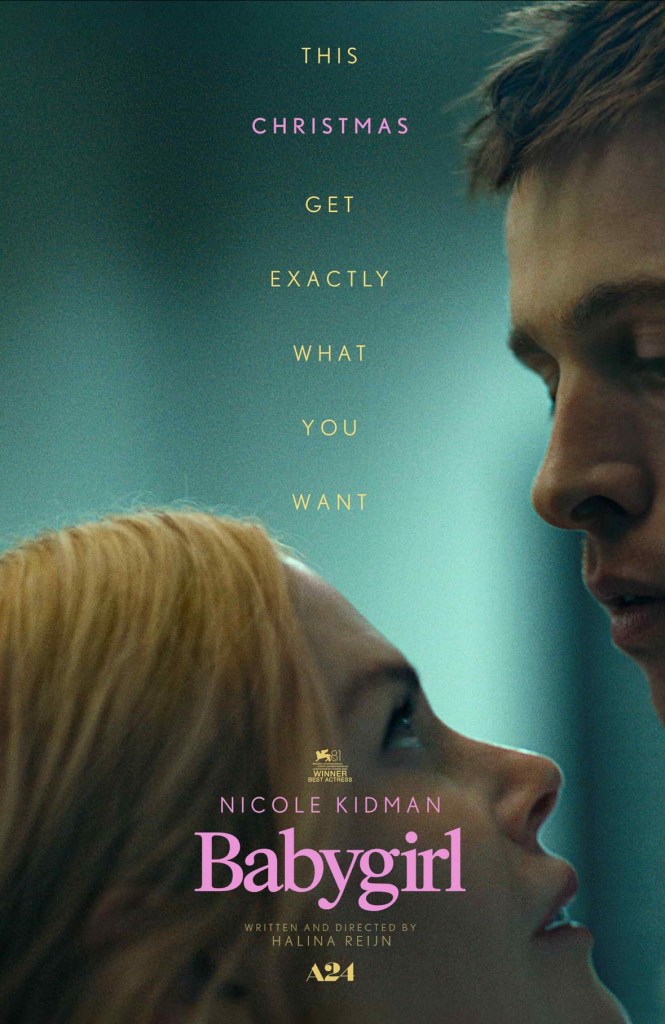
A business woman risks her career and the safety of her family for an affair with a young intern at her company…
There’s a primal relatability to Babygirl, a journey of sexual repression and shame that manifests into a self-immolation of foundational morals and ethics. The carnal quality of Babygirl becomes secondary to the chaotic consequences of its plot as its protagonist veers deeper and deeper into a desirous hell of her own making and we find ourselves hard pressed to look away. Babygirl’s plot can be chalked up to a series of bad decisions, yet at its core it offers fundamental lessons about shame that cut to the core of sexuality as it is often expressed—or perhaps not expressed—in the modern age. It doesn’t matter if Romy (played with indelible sensitivity by Nicole Kidman) has sexual desires that the audience deems uncontroversial. The key component that the film hinges upon is that Romy feels shame for her desires. Shame is intrinsically tied to sex for many of us whether through past traumas, vulnerabilities, over exposure to pornography, a smattering of all of the above—simply take your pick. It speaks poignantly to the heart of the film that Romy’s husband is played by the hyper-masculine Antonio Banderas. It is not through lack of ability that Romy cannot achieve her sexual desires with her husband—there is simply not a soul in the theater who would believe Banderas incapable of dominating in a positive sexual way—but it speaks to the power of Romy’s shame that she won’t allow herself the opportunity for vulnerability leading her to the arms of a virtual stranger in Samuel. Dickinson’s performance is a subtle one, a character presented as a virtual blank slate on which circumstances can breed toxicity. Samuel is as inept at providing Romy her fantasies as she is in advocating for them, but the earnest effort to try, and her ability to find comfort in his absence of character as if to avail herself of moralistic hesitation, offer the opening for the eroticism to seep through the discomfort. Babygirlnever shies away from the inherent awkwardness that accompanies sex, often finding more joy in watching these actors fumble through their insecurities in an effort to connect to a physical truth between them. As a result, Babygirl is as uncomfortable to watch as it is thrilling or titillating, but this is to its strength. Babygirl is an authentic film about carnal desire finding its way through the oppression of self-inflicted wounds and shame-induced safeguards disguising themselves as moral scrutiny. It’s a lesson, a cautionary tale, about being honest with oneself before being able to find honesty in another person. Babygirl’s pacing forces too much in its final third and rushes through crucial moments with such ferocity that the audience is almost waiting for a cheap reveal that it was all a bad dream. But the character work is ingenious in Halina Reijn’s script as it always manages to illicit sympathy for Romy amidst her crisis. At the end of the day, we will always be the villains of our own story no matter how much other stories may villainize us. Finding grace within these moments, learning the lessons to release ourselves from the shackles of our self-imposed imprisonment, is the only way forward for fear that we may repeat the cycle again. 9/10
7. Didi
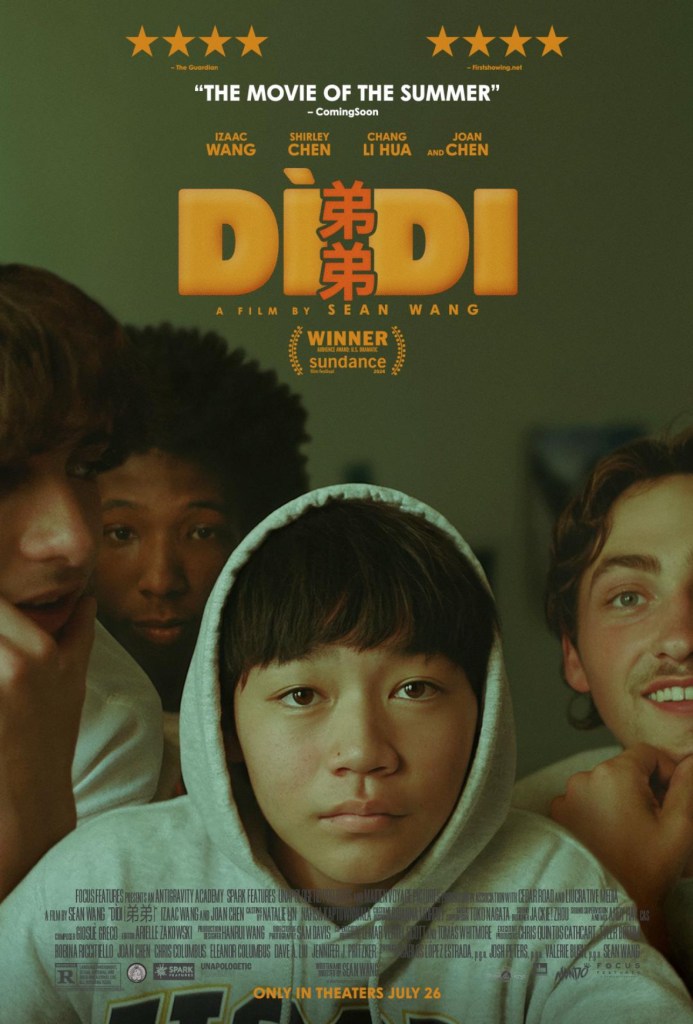
A snapshot of the summer between 8th and 9th grade as young Chris must navigate the pressures of change in the evolving world of 2008…
It’s almost difficult for me to write about Didi on account of its uncanny accuracy in relaying to me a thoroughly detailed exploration of my own life. There’s a journalistic accuracy to the approach that is discomforting watching as a young, creative adolescent transitions into high school while overcoming the pressures of teenage angst, the dawn of Facebook and AIM, the social anxieties of making new friends and keeping old ones. Chris isn’t merely relatable because of his circumstances (though it is also unnerving for me watching his enemies-to-friends relationship play out with his older sister just as she leaves for college, an exact replica of my relationship with my own older brother complete with an identical age differential) but also because of how Chris deals with these pressures. The social self-implosion manifesting into a depressive state of isolation and loneliness could have been lifted directly out of my own 8th grade journal. That said, there is a fair bit more to glean from Didi than my own circumstantial connection. This is a story about Asian American identity, demonstrating several customs and generational points of view that deepen Chris’s isolation as he struggles to find his personal identity. But there is a universality to that uncertainty that only masterful filmmakers at their most vulnerable, their most honest, can seem to achieve. Didi is an often hilarious movie demonstrating the reckless abandonment of youth as it’s carefully siphoned out through the recognition of age. Chris has juvenile passions, but they are passions nonetheless. The drive to suddenly make something of them catapults him towards circumstances that on the surface seem precarious, but Sean Wang’s expert script always manages to walk the tightrope of danger and fun to allow for a more precise reality to overlay the film. It’s a movie where, like youth in real life, there’s always a threat of something truly awful happening, but the real pain and trauma can be derived simply from growing up in this gradual state of complex uncertainty. The lovely assembly of this ensemble cast drags in a variety of different adolescent socialites each at varying levels of confidence to draw direct comparisons back to Chris as he struggles with his own identity, but it is Joan Chen who comes away with the star making performance. As Chris’s mom, she fights with a tender care to connect to her children who seem insistent on running away. Chen’s performance is staggering in its quiet moments as she glances toward the uncertain future of her own life in tandem with her kids, yearning to simply fix the pain that the world inflicts so naturally with its cruelty but knowing she is powerless to do so, knowing that she can only be a mother and praying that can be enough. Didi is a slice of life picture. It’s insistence on leaving threads open ended to leave room for Chris’s real future may leave its audience feeling more like they read the first book in a promising series than completing the journey of a cinematic film. There’s a deliberate dissatisfaction to the resolution, but if the film’s biggest flaw is that it ended, then I’d surmise that it was a pretty excellent film. 9.3/10
6. Nickel Boys
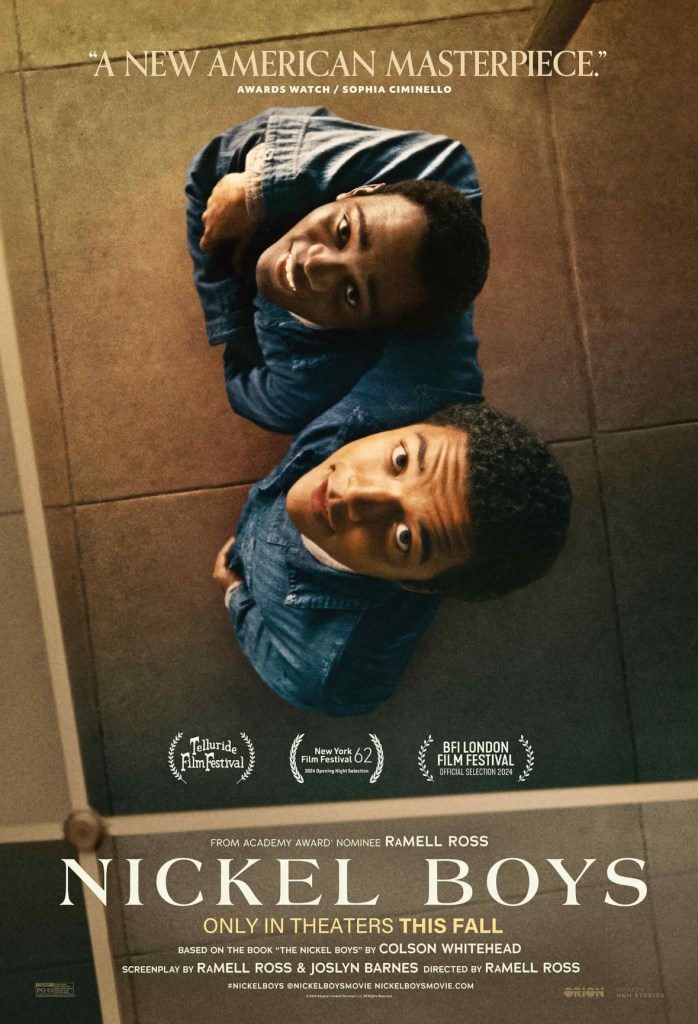
A friendship between two African-American boys as they’re forced through isolation and racist oppression in the pressurized environment of a reform school, Nickel Academy…
There’s a version of Nickel Boys that exists in another universe made by another director that still manages to stir the hearts of its viewers, but in this adaptation of Colson Whitehead’s award winning novel, Ramell Ross’s directorial flourish makes for one of the most visually arresting pictures of the year. The choice to shoot the film primarily in first-person (and by some extension, an argument could be made that it is inadvertently second-person as well) is a bold stroke that could easily deter narrative intrigue. Indeed, in the first act of the film, the stylistic choice almost feels self-indulgent, too ambitious for its own good, as audiences may find themselves uncomfortable or hesitant to buy in, worried that Ross’s vision can’t justify its aesthetic choice. This is a remarkably faithful adaption, one that’s best left unspoiled as it re-contextualizes itself with each delicate moment, but it demands to be said that upon the film’s conclusion, once this directorial choice earns its narrative justification as if to say our trauma removes us from the inner workings of ourselves, forces us into a perpetual state of dissociation, there is simply no doubt that the directorial ambition pays off. There’s a delicate quality to Nickel Boys, or as Ross describes it, ‘the epic banal,’ the idea that our lives consist of moments that feel precious in our desire to preserve the simplicity of them. The epic banality of riding the bus or seeing the lights that pepper a street around Christmas time. The epic banality of a hug. The epic banality of watching paint dry. Nickel Boysis a movie so adorned in tragedy but so wisely showing us the moments we should be grateful for instead. It refuses to linger on the torment and trusts instead that our lives will do enough of that for us. Instead it shows us a series of attempts at life reaching back through the camera to grace us with the opportunity to appreciate something deeper. I feel like a broken record in making yet another declaration for Aunanue Ellis-Taylor to win an Oscar as she manages to ground this film so effortlessly. Ellis-Taylor is transportive taking the audience with her as she fights to connect with them. Her motherly presence acts as the guiding light, the beacon that the character’s—and by association, the audience—strive towards. Nickel Boys is a somber, quiet triumph of a movie. It’s a film that is precious with its source material adding an audacious lens to this pristine story in an effort to heighten its emotional intent. It’s a traumatic film, one that is likely to awaken deep feelings in its viewers. And for that, I am grateful it exists. 9/10
5. Challengers
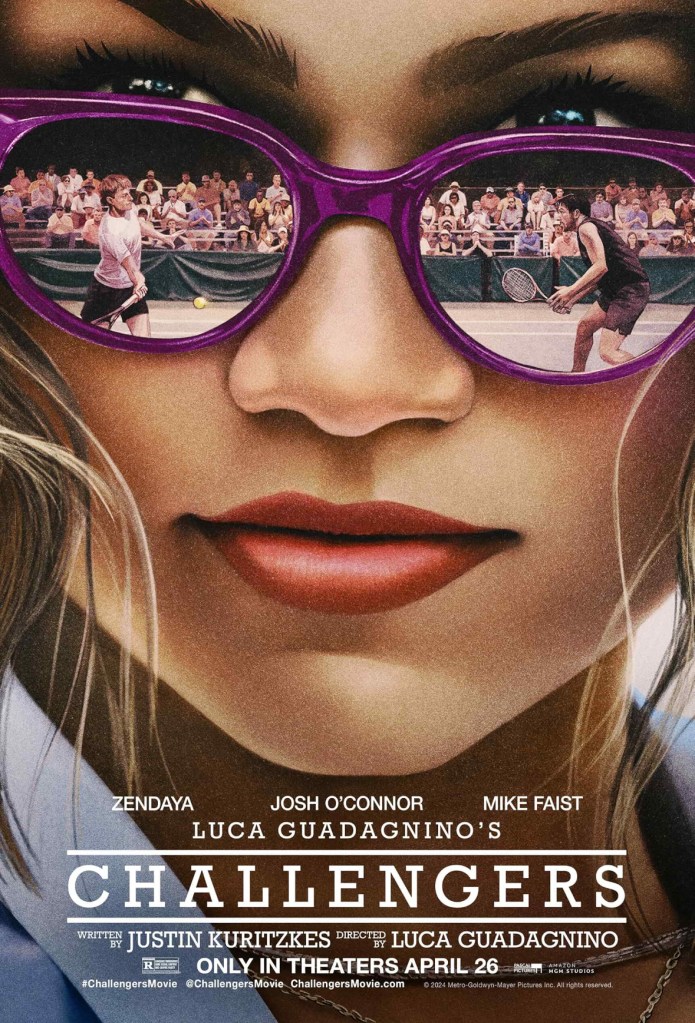
A former tennis prodigy now turned coach must force her husband to break his curse of lost confidence by beating his once friend turned arch rival, her ex boyfriend…
An absolutely propulsive exploration into the most primal form of love and lust, Challengers is a triumph of precise scripting working in tandem with explosive direction. Luca Guadagnino has been a director working at the height of his artistic prowess for several years now (in 2024 alone, he released two films both of which are likely to be major awards contenders), but Challengers feels like the culmination of everything he has built towards, a stylish melodrama bristling with eroticism and levity at every turn. With each frame of this carefully curated visual yearn-fest, Guadagnino obsessively highlights sex and lust without ever showcasing nudity. Each shot captures an essence of innuendo, a fascinating exploration of human bodies at the height of passion. One could argue a sense of self indulgence in the camerawork here, often opting for the most interesting visual in lieu of something that may better serve the story, but big swings in the directorial vision are what make Challengers so much more than just another sports movie. Tennis becomes an allegorical concept for the violent lust of our three protagonists. The screenplay by Justin Kuritzkes crafts three lovable anti-heroes each fighting through the pomp and frill of tennis and showmanship to capture the love that eternally waits on the other side of the literal and metaphorical net. Patrick, a self-admitted asshole, is perhaps the most honest of the three, always driving towards his goal with acute sincerity if not outright dismissiveness of the consequences. Art tactically guides the game of their love triangle to his whims, yet he feels lost in wanting to settle his life and career down but being relegated to playing second fiddle to his wife’s passions. Tashi is all at once the film’s most sympathetic character and its biggest villain, a woman so obsessed over control of her own life that once its stripped from her she has no choice but to find a vessel to live vicariously through, someone who still sees her as more than the promise of the woman she was in order to give purpose to the woman she wishes she could be. The simplicity of this dynamic can be defined in primitive terms: Patrick wants Art, Art wants Tashi, and Tashi wants tennis (if you read deeper into that basic stating of wants, then you’re right where the film wants you to be). In framing this as the conceit of the story, every action and reaction enacted by these characters comes into focus through propulsive yearning and complicated backstabbing leading to a chaotic, nonlinear narrative that ups the stakes of every game with each subsequent scene. It’s a masterful screenplay that Guadagnino mines every crevice of for maximum visual, political intrigue between these uniquely flawed and earnest characters. The performances from our three leads are reliably great particularly Josh O’Connor who imbues Patrick with such a breadth of hopefulness as he yearns to bring the band back together and live the glory days of bisexual passion. The film is punctuated with Trent Reznor and Atticus Ross’s finest score since The Social Network, a series of electronic, synth-heavy compositions that frenetically pulse through each scene in key moments to heighten the thematic correlation between tennis and life for these three challengers. As someone who grew up with tennis, it came as a shock how easily Guadagnino and company crafted the scenes of the actual sport itself, treating each stroke as a piece of choreography and using a CGI ball to allow Guadagnino and cinematographer Sayombhu Mukdeeprom to maneuver the camera with a series of increasingly stylish flourishes that capture the propulsive feeling of seeing truly great competitive play. The movie earns its high stakes excitement, but its true mastery is in witnessing its effortless moments, the key points in which simply holding a ball between a racket’s base has stronger implications to the narrative than anything. 9.7/10
4. Dune: Part Two
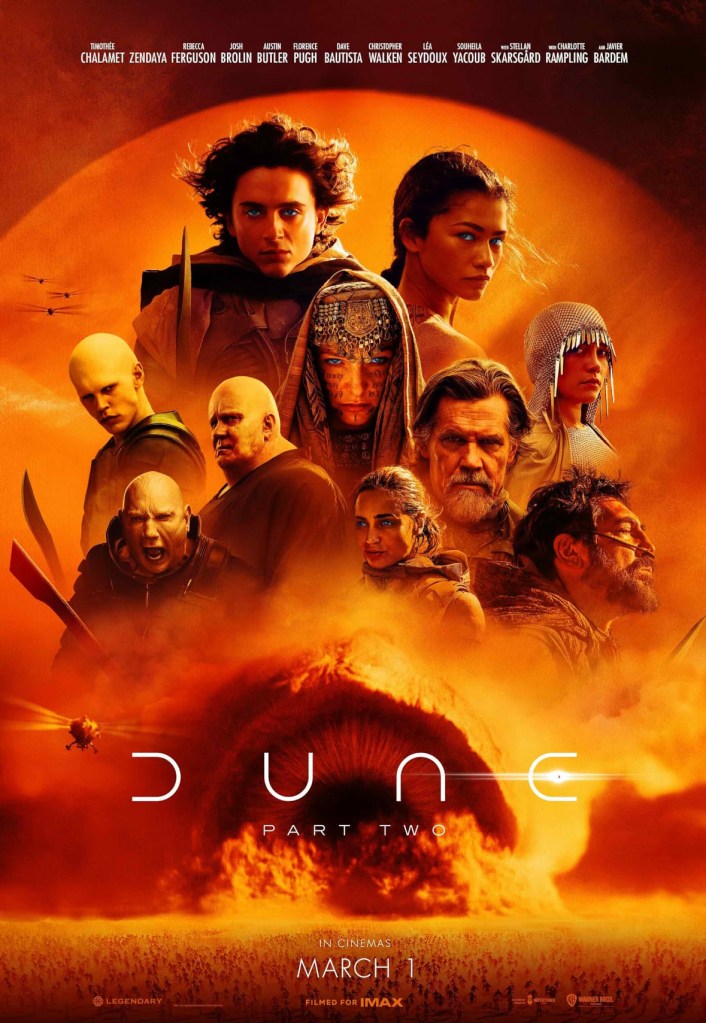
A continuation of Frank Herbert’s science fiction epic, Paul Atreides must learn the ways of the revolutionary anarchists on Arrakis in an effort to reclaim his family’s power…
Dune: Part Two is what cinema is about, an unparalleled theatrical experience combining high fantasy/science fiction with emotional gravitas, explorative visuals, and groundbreaking effects. Denis Villeneuve’s Dune duology is event cinema coalescing every art form to blend into an adaptation of one of the best science fiction novels of all time. Where Dune: Part One was the promise, the setup that showcased Villeneuve’s reverence for the project and his artistic merit in achieving his vision for it, Dune: Part Two is the payoff giving the audience every ounce of spectacle and character stakes that they could have possibly conceived of. As of fan of Frank Herbert’s masterpiece, I hesitate to embrace every change in this mostly faithful adaptation. My bias toward Gurney’s character demotion here (removing my favorite scene in the entire book in the process) or the omission of Thufir Hawat is enough to make me bristle, but Villeneuve and co-writer Jon Spaihts delicately earn the good faith of nerds like me scene by carefully curated scene. Paul’s rise to Fremen idol is not only gradually and subtly engineered as in the novel, but now it is fully pronounced in a scene so captivating it feels as though the ghost of Frank Herbert himself crafted it. It is a crime against humanity that Han Zimmer’s masterful score has been marked ineligible for contention at the Oscars considering his theme notes that carry over from Dune: Part One are only a fraction of the propulsive, otherworldly musical composition that elevates every scene in this film (the Harkonnen arena piece should be enough to preemptively win an Academy Award for the next 3 years let alone this year). Cinematographer Greg Fraser continues to be an absolute madman at the height of his craft framing each of the technically flawless visual effects with such mastery, but taking special care to keep the intimate scenes just as thrilling (and once again, the Harkonnen arena scene…there are simply no words to string together that can properly praise filmmakers like this for inventing a visual aesthetic so unique, alien, and visceral). Editor Joe Walker will surely be a name called on Oscar night, stringing this epic together with such delicate mastery that compliments all of the other pieces at play. Perhaps my only controversial take removed from my adoration of Dune is to say there are some performances that I am not as captivated by as the proverbial streets of Twitter seem to be (I find certain actors forcing elements of the narrative without taking better care of the character work that gets them from scene to scene), but I should take very special care to say that Austin Butler is magnificent. Feyd Rautha is given the added bonus of being the most interesting character in Villeneuve’s adaptation, but Butler’s work here is transformative in crafting a villain so fixated on violence and physical dominance that he runs the risk of politically overhauling the course of the pre-destined narrative. Dune at its very best is a political science fiction thriller. The script takes care to lay bare the maneuverable pieces for the uninitiated and certainly crafts a more digestible narrative than Herbert’s vision is credited with. That being said, some things can come across as jarring by proxy (i.e. don’t be alarmed when you discover they have nukes just…siting there). But the pieces are all there. And if you find yourself sitting next to a Dune fanatic in sharing this experience, don’t be afraid to ask them for clarification because—speaking from experience—it will be the best part of their day. Movies should be a conversation between all art forms, and the better they work in tandem with each other, the better the final product of the film. If that is the thesis, Dune: Part Two should be the definition’s example. 9.3/10
3. I Saw the TV Glow
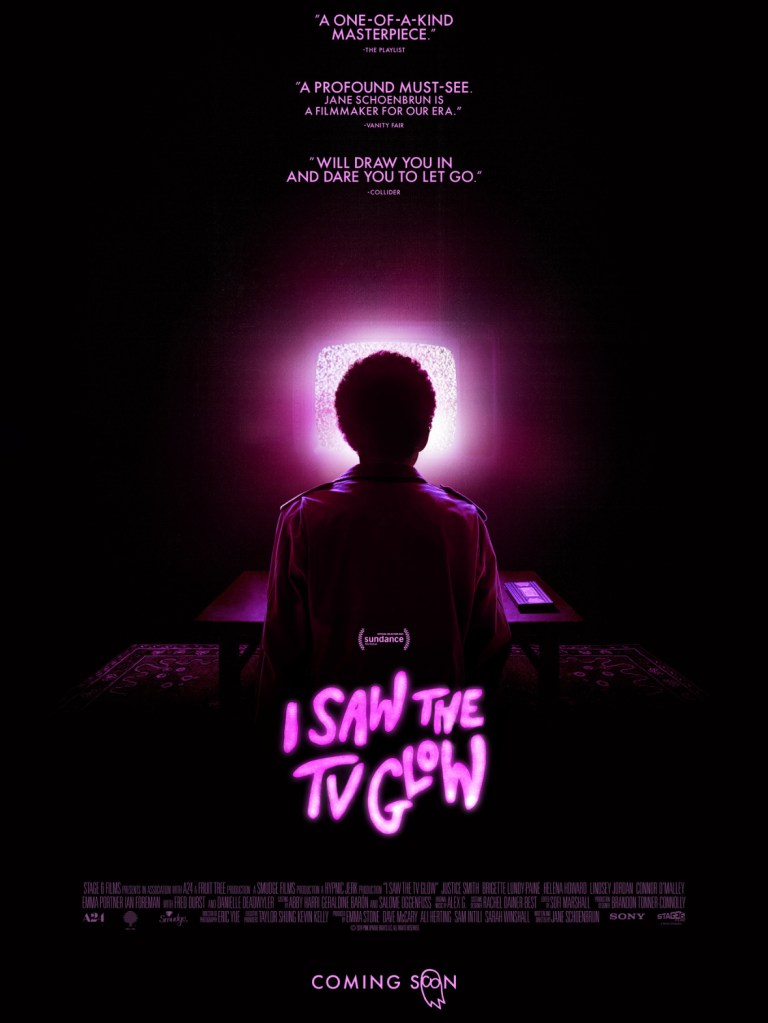
Two teenagers connect over their shared adoration of a young adult 90’s television series only to find themselves increasingly lost in the dreary world around them…
I go back and forth between struggling to recommend I Saw the TV Glow on account of its genre-less, confounding nature, and consequently thinking it may be the most important millennial film of the decade. It took me a few times watching I Saw the TV Glow for it to infect me with its indescribable magnetism, but it was one I kept coming back to over and over again. I Saw the TV Glow is an uncompromising vision from a filmmaker at the absolute height of their craft, channeling the cinematic menagerie of nostalgia and an ethereal dreamscape into a melancholic, understated tragedy of being trapped in a life against your will. I Saw the TV Glow is unabashedly a film about the trans experience (it can be easy to miss if you’re not paying attention, but the movie very overtly acclaims as such even going so far as to use a children’s parachute decorated in trans-flag colors at the film’s outset), but its thematic nature speaks to the core of everyone. I’m not an authority to speak on the trans experience, but I am an authority on what it means to feel trapped, confounded by the machinations of an oppressive world that seems to conflate anxieties within my brain and pronounce them as monsters within my thoughts. I don’t mean to use this review as a diary or a declaration of my own mental illness, but instead I mean to draw attention to the universality of the human condition and how I Saw The TV Glow speaks so loudly to it. (Slight spoilers in the next sentence) The structure of the film is a masterwork, deliberately depriving itself of a third act as a reflection of the central character’s plight in settling within the confines of imprisonment. This speaks nothing for the soundtrack, a carefully curated list of songs that director Jane Schoenbrun advocated for from their favorite artists that essentially defined the film and culminated in one of the most provocative literary compliments to a movie that I can remember. Anthems for a Seventeen Year Old, a new contender for my favorite song of all time, speaks to a yearning for times now past, moments when we were young and couldn’t appreciate the simplicity of youthful connection. There is perhaps nothing more comforting to a depressive state than the feeling of shared experience. The morbidity of hearing, “I think I was born bored, I think I was born blue, I think I was born wanting more, I think I was born already missing you,” may feel to some like an irrelevant literary device, a narrative structure to a song that sounds pretty and sad, but to me Claw Machine is a ballad that speaks to the film’s core identity. One day, perhaps, I can write a retrospective breaking down each of the film’s songs and identifying their influence on the film itself, but for now I will resign to these few moments to spare the modest readership of this review from my somber musings. The performances in I Saw the TV Glow are hyper stylized often harkening back to 90’s Television melodrama to better influence the film’s central plot. At times, this attention to detail with the direction of the performances can cause a lack of relatability for the audience, particularly those who may have no familiarity with the homages of such stylized work. There are things that this film discusses that seem to be entirely unique to the way Schoenbrun talks about them. The hyper fixation of nostalgia pieces (“sometimes, the Pink Opaque feels more real than real life”) and the isolation of such emphatic draws to art that somehow remove us from connectivity to the world, only to then discover the unabashed preciousness in finding someone of a like mind to share with. The collective unconsciousness that leaves us all meandering through the halls of a dreamscape, blinking as years pass by in a fugue of dissociative identity. The fear of breaking out of the mold of comfortability. The desperate cry that you apologize for that no one even hears as you’re left prisoner to your own mind and body. If you relate to none of these, then perhaps I am alone in my adoration of I Saw the TV Glow, but for those who are willing to linger here, for those willing to engage with this film’s dreary liminal space between dream and wake… This is for us. “Park that car, drop that phone, sleep on the floor, dream about me.” 9.5/10
2. The Brutalist
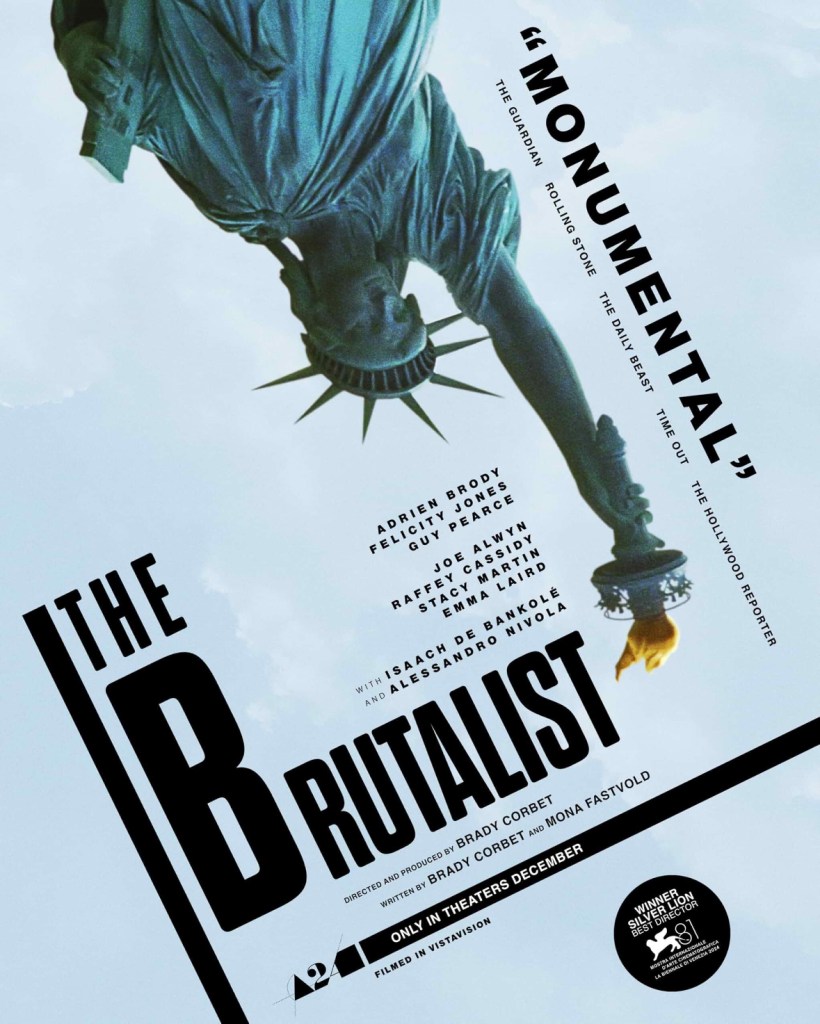
An odyssey spanning several decades as a prolific architect flees post-war Europe and navigates his own legacy amidst being hired by a high profile client…
At its core, cinema is a magic trick showing the audience a card, allowing them to see it, feel it, even hear it as it shuffles back into the deck before a final prestige, a flourish of revelation, transporting them into the land where the card and only the card exists. The Brutalist is a magic movie. It is transportive cinema. It is a masterstroke of immersion, a grandiose epic that feels unmatched in its scope yet intimately engrossing all the same. There’s simply not enough praise that can be offered to a film like The Brutalist, a movie so uncompromising in its vision that it bakes itself into the very fabric of film history at its very outset. It sounds like hyperbolic praise, but I know of no other way to express my adoration for The Brutalist. “Is there a better description of a cube than that of its own construction?” Perhaps the best way to describe The Brutalist is in first identifying the artistry that constructs it. The expansive script from Brady Corbet and Mona Fastvold. The triumphant and twisted score from Daniel Blumberg. The sublime cinematography by Lol Crawley complete with the inspired choice to shoot on Vistavision giving each frame the widest space imaginable for the film to capture the breadth of creativity that occupies architectural landscape and figures at its center, as if to say this is Laszlo’s very own mind sketched out onto this film’s vast canvas. Much can be said about The Brutalist’s shockingly minimalist budget, but this is a film that could have been made for 100 million and I still would sing its praises. The direction of The Brutalist is sublime as Corbet imbues every scene with dense attention to detail, a historically rich piece of cinema that braves to make each frame feel consequential in its ties to theme, character, and historical context. The scope of Laszlo’s arduous journey in America is monumental, yet as a singular character he feels so flawed and earnestly sympathetic. The Brutalistnever frowns upon Laszlo’s vices, but it also never shies away from them. We watch as he succumbs to the pressures of drugs and sex, his creative prowess infringing on his ego in ways that may even seem unlikeable at times. This level of flawed characterization only deepens the audience’s admiration of Laszlo. He’s a complex protagonist. At times, he can even be hard to root for. But he is also wildly empathetic. He is a fighter, a creative trapped as a journeyman campaigning against the odds of an oppressive world to find the source of connective purpose within it. He is self-admonishing (consider one of the film’s very best scenes—a litany to choose from, I know—in which Laszlo lays beside Erzebet in their first reunion) and conflicted about a country that seems hellbent on praising and dismissing him in equal measure. It should go without saying that Adrien Brody delivers one of the finest performances of this year and perhaps this decade in finding these deep, unruly inner workings of Laszlo and guiding the film through his authentic feelings. The task is insurmountable to a lesser performer as Laszlo is tasked with carrying the film both narratively and spiritually, taking on the brunt of its thematic purpose in every scene. The supporting cast around Brody, particularly Guy Pearce and Felicity Jones, each manage to assist the Sisyphean effort of carrying this monumental load. But this is Brody’s show, and show he does. It’s virtually impossible to describe the thematic weight of The Brutalist in its entirety by the film’s end. One could glean any number of things from its staggering messages. The pressures of capitalistic confines that threaten to devour artistry, the wolves in sheep’s clothing and fine suits who value creativity only insofar as they can dominate it, the arduous and never-ending process of integrating into a new society only to be constantly ostracized by the oppressive nature of its people, the list is endless. Some of these thematic pieces may seem heavy handed for viewers, particularly in the film’s second half as they’re brought more violently into focus. Even the film’s final line is likely to divide many on its meaning. But the best scripts are the ones that lay down the clues for the audience to draw their own conclusions. Above all messaging, however, one cannot walk away from The Brutalist with any other conclusion than it being a masterpiece of historical fiction. 9.7/10
1. Anora
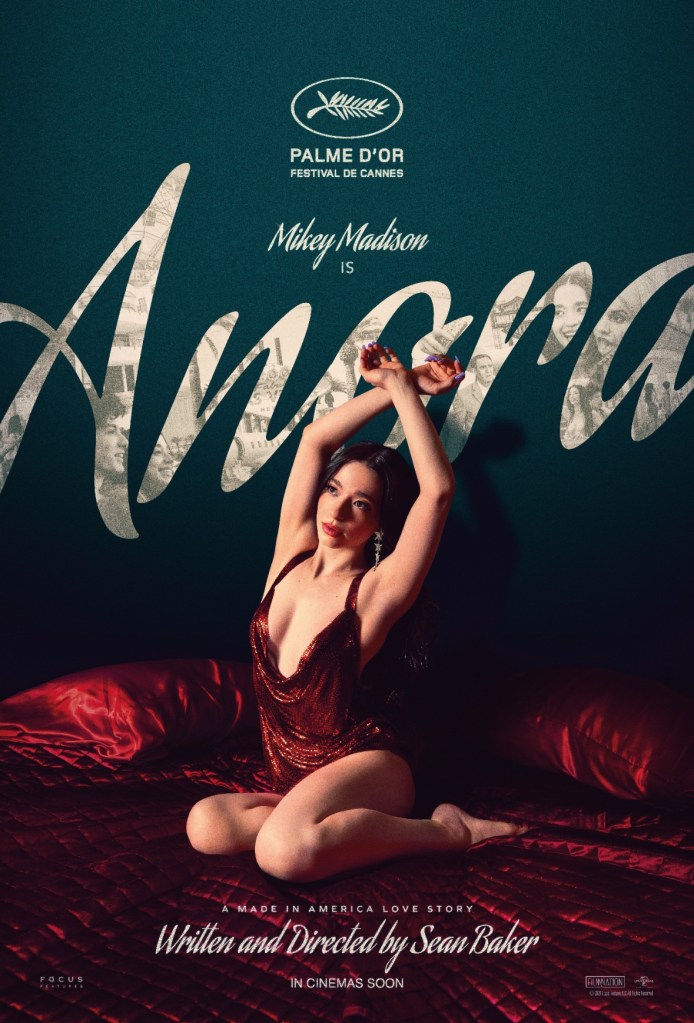
A Cinderella story for a modern age as a stripper turned rich wife must scour the streets of New York in an effort to find her husband and reaffirm her identity…
There are films, and then there are films that feel as though they were singularly made for you. Anora scratches the itch of everything I long for in a movie, a surprisingly earnest story of reclamation of personal identity through a skewed perception of love that blossoms into a wildly chaotic journey leaving room for any and all possibility in the turbulent odyssey. Best described as Pretty Women meets Uncut Gems, Anora feels like watching pure joy of unadulterated frivolity only to then use its goodwill to rip the audience’s heart out in its final moments. Sean Baker’s capitalist critique weasels its way gradually underneath the overt insanity of its second act. The script is brilliant in its subtlety, so distinct and casual in its promises that viewers may miss its nuance in the wake of its showier set pieces. Ani is a character tailor made for my sympathies, a woman so intrinsically tied to capitalistic exchanges by pure merit of her job title that she is resigned to wait patiently for the opportunity to reclaim her sense of personal identity. When the opportunity is presented to become a wife in lieu of a sex worker, it feels like the means-to-an-end finally found its end. This is not to say the movie showcases disparaging views towards sex workers—quite the opposite in fact—but the film doesn’t hide its opinion on the monetary exchange of body and autonomy. Throughout Ani’s 2nd act quest, a looney toons inspired odyssey that will likely make you burst into raucous laughter, the film is consistent in its insistence on Ani’s quest. Baker’s film breaks all conventions of filmic structure as it makes its own rules for pacing leaving a first time viewer wondering where they’re going to land. But it is Mikey Madison’s star making performance at the film’s center that channels the chaotic, unpredictability that fuels this bizarre misadventure. Every scene in the film’s second act feels like a hilarious nightmare unfolding in increasingly unique ways as Ani struggles to adjust and readjust to circumstances leaving Mikey Madison as a performer fighting with increased clarity for her character to survive the unending setbacks. The ensemble cast that builds around her is complete with a dazzling circle of stars-in-the-making, all with a brilliant aptitude for improvisation and comprehension of tone. Moments that could otherwise prove unremarkable—the grabbing of a baseball bat or making a toast on an airplane—invite the audience to celebrate them in their often hysterical reinterpretation or redeclaration of who these characters are. Watching Yura Borisov’s calculation of Ani, seeing as each of these characters observe things about each other, becomes as integral to the viewing experience as the audience observing things themselves. Each piece of this cast unites so perfectly that the film feels like a treasure trove of moments catching one after another of these very real, earnest, flawed individuals chewing scenery and grounding this world in all of its glorious chaos. There’s a moments towards the film’s final third (featuring a plane) in which Baker’s script, which is otherwise uniformly excellent, cannot seem to justify Ani’s decision to stay the course. But ultimately, this is not a fight for love. It’s a fight to be recognized—to be loved—in the face of a world that feels conditioned to only represent character through what they can offer. This idea is so pervasive that it culminates in one of the most powerful endings of the year, a moment consistently misinterpreted by the online masses who miss entirely that the scene is predicated upon another exchange, the exchange of a ring. I think every great film, at its core, is about connection. Connection to self, connection to others, connection to an audience, to a personal sense of identity, to a larger purpose, to a fading life, to a past, a present, a future. There’s a reason Anora is the title of the film despite the titular character’s continued insistence that she’d like to be called Ani. We’re all fighting for our heads, every day, fighting against the persecution of our own inner turmoil in tandem with the persecution of a world that wants to relegate us to our ‘value’ and what we can ‘offer’. Anora is a marvel because it manages to say all of that amidst the constant uproarious hilarity of watching a group of buffoons galavanting through New York City in a desperate attempt to preserve their own self-worth. 9/10


Leave a Reply